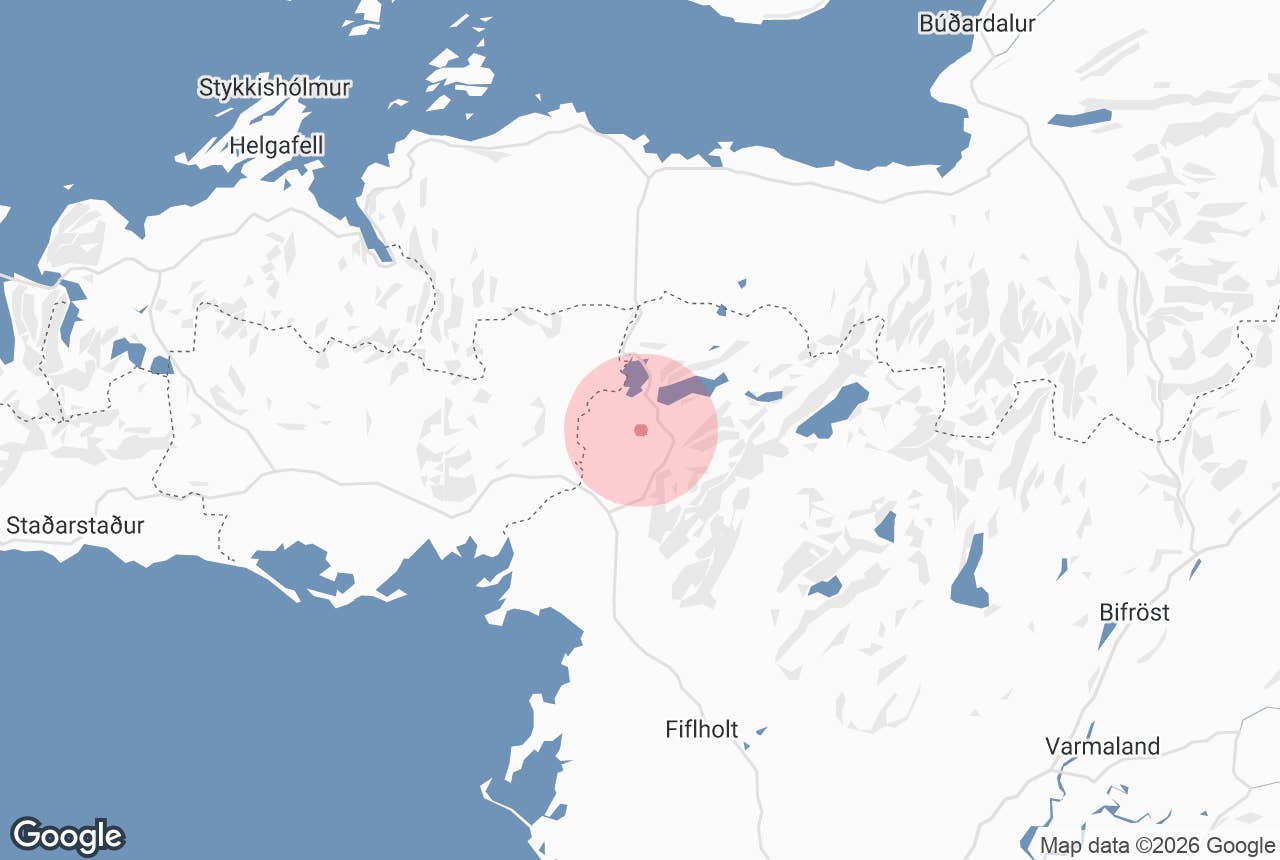
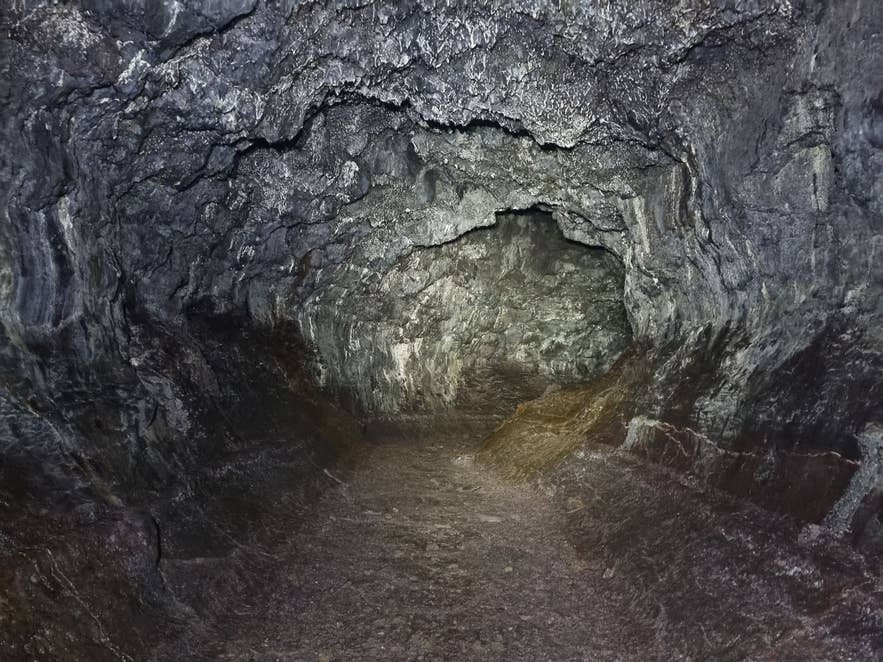
Main passage of Borgarhellir lava cave
Borgarhellir is a lava cave in Gullborgarhraun, the lava field around the crater Gullborg in Hnappadalur, on the south side of the Snæfellsnes peninsula in West Iceland. The name means "cave of the borg", borg being the Icelandic word for a fortress-shaped crater hill.
Borgarhellir cave is one of a cluster of lava tubes in this 15 sq km prehistoric lava field, known together as Gullborgarhellar and listed on Iceland's Nature Conservation Register; its neighbours are Gullborgarhellir, the longest at about 670 m, and Vegghellir.
Sources do not agree on the names: Icelandic Wikipedia calls the 670 m cave Borgarhellir, while radholar.is calls it Gullborgarhellir and German Wikipedia gives Borgarhellir a length of 423 m. This is wild caving: there are no lights, boardwalks or ticket desk, and the cave is reached on foot across rough lava.
It is the cave visited on EV Travel's private caving tour from Reykjavík.
Key Takeaways About Borgarhellir
- Wild lava tube, listed on the Nature Conservation Register, in the prehistoric Gullborgarhraun lava field (about 15 sq km), Hnappadalur, West Iceland
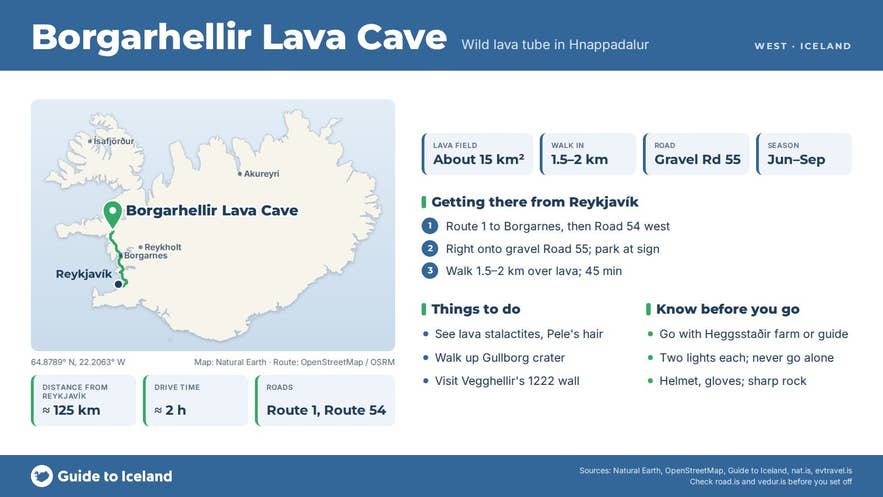
- About 125 km / 2 h from Reykjavík via Roads 54 and 55; no 4x4 needed, but Road 55 is gravel
- 1.5–2 km walk each way over rough lava from the roadside; allow 45 minutes
- No lights or facilities; permission from Heggsstaðir farm or a licensed guide is required
- Neighbouring caves Gullborgarhellir (670 m) and Vegghellir (320 m, with a wall dated to 1222)
Why visit Borgarhellir
The Gullborg caves are among the least altered lava tubes in Iceland. The eruption that built Gullborg and its lava field happened in prehistoric times; published age estimates range from about 2,000–3,000 to 7,000–9,000 years.
The tubes it left behind were rediscovered in 1957 according to Icelandic sources and are listed on the Nature Conservation Register, so their formations have not been stripped as in many caves nearer Reykjavík.
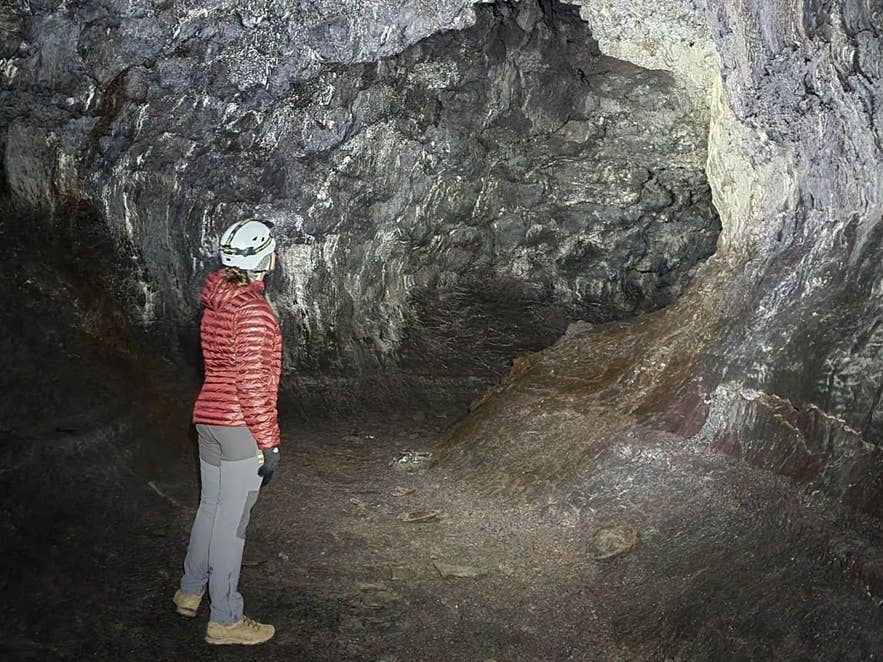
Inside Borgarhellir lava cave
Inside, Borgarhellir cave has what a lava tube should have: a roof that has barely collapsed, a wide original passage, and lava stalactites hanging in clusters, with drip ridges and flow lines on the floor and walls.
Guided groups also look for Pele's hair, fine threads of volcanic glass spun from the lava as it flowed. German Wikipedia gives Borgarhellir a length of 423 m.
In the 670 m cave described by radholar.is as Gullborgarhellir, the first 170 m cross a rough late-stage lava tongue, the passage splits in two about 260 m in and rejoins further on, and the innermost section is chained off to protect the most delicate formations.
The lava field has a second story. Vegghellir ("wall cave"), about 320 m long, contains a man-made stone wall about 74 m inside the entrance that local tradition dates to 1222 and links to Aron Hjörleifsson, a follower of Bishop Guðmundur Arason who hid from his enemies during the Sturlung Age feuds.
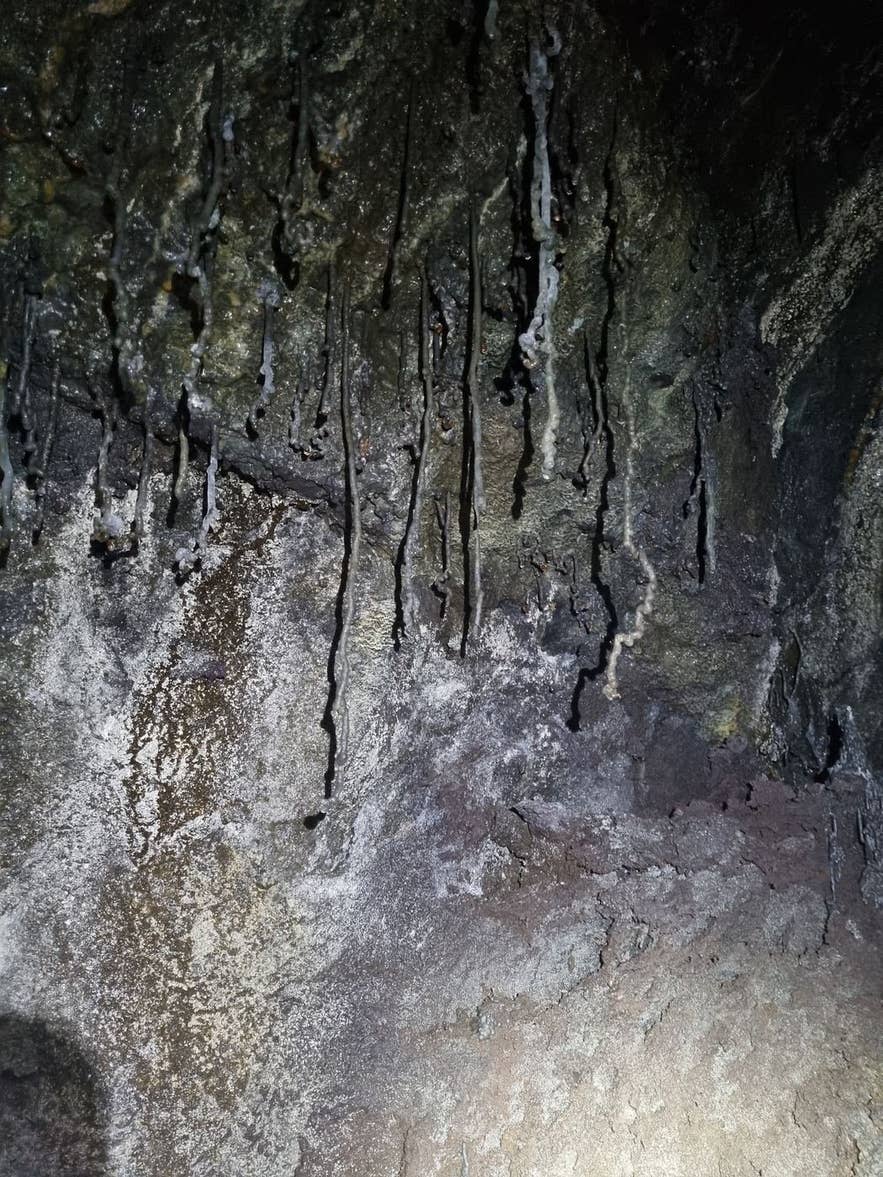
Lava drip formations in Borgarhellir
Above ground, Gullborg crater itself (143 m) can be walked up for a view over Hnappadalur and the Ljósufjöll volcanic ridge.
How to get to Borgarhellir
Gullborgarhraun lies about 125 km (78 mi) from Reykjavík, around 2 hours by car, and about 50 km by road north-west of Borgarnes. From Borgarnes take Road 54 (Snæfellsnesvegur) west, then turn right onto Road 55 (Heydalsvegur), which runs north-east through Hnappadalur.
The lava field and the Gullborg crater lie beside Road 55 near the farms Syðri-Rauðamelur and Heggsstaðir, and a roadside sign marks the caves. Road 54 is paved; Road 55 is mostly gravel but passable for ordinary cars in summer. No 4x4 is needed.
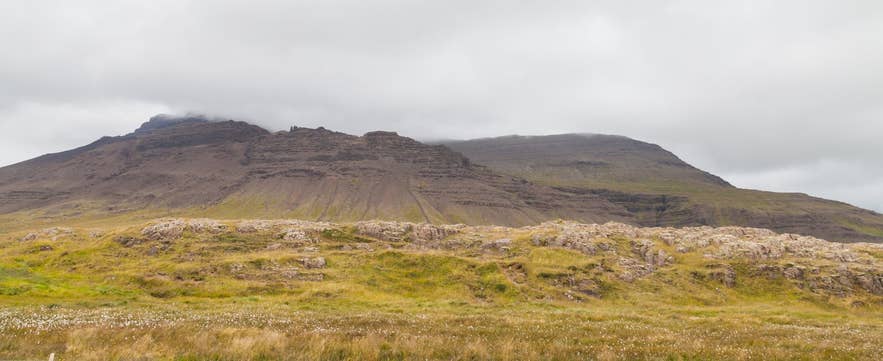
Hnappadalur valley, West Iceland. Photo: Diego Delso, CC BY-SA 4.0
From the parking spot it is a walk of about 1.5–2 km across the lava on a worn path to the cave entrances, which open at the edge of a low cliff not far from the crater.
Allow 45 minutes each way; the surface is uneven and sharp. One published GPS record of the round trip to the caves and back is 3.7 km.
The caves are on private land and, according to nat.is, may only be visited accompanied by someone from Heggsstaðir farm; arrange this with the farm or go with a licensed operator who has access arranged.
Best time to visit
June to September is the practical season: the gravel road and the lava path are free of snow, and daylight for the walk is not an issue.
Inside, lava caves stay cold all year and ice can linger near the entrance into early summer. Winter visits are only sensible with a guide, since the path across the lava disappears under snow and the entrance ice is treacherous.
Safety and practical tips
- Never go in alone, and carry at least two light sources per person. Leave a note on your dashboard with names, numbers and expected return time, or tell the farm.
- Wear a helmet; roof heights change constantly and the rock is sharp. Gloves and sturdy boots are essential, and knee pads help where you crawl.
- Do not touch or break formations. The lava stalactites formed in a single eruption and will never grow back. The chained-off section of Gullborgarhellir is closed for that reason.
- Mobile coverage is poor in the valley and nil underground.
- There are no toilets, shops or shelter at the site. The nearest services are in Borgarnes.
- Guided trips supply helmets and headlamps, and require participants to be 10 or older and reasonably fit for boulder scrambling.
Nearby attractions
- Gullborgarhraun – the lava field and crater the cave lies in, 1.2 km
- Hnappadalur – the valley between Snæfellsnes and Mýrar, 1.4 km
- Ljósufjöll – the pale rhyolite mountains above the valley, 0.4 km
- Rauðamelsölkelda – a naturally carbonated mineral spring, about 5 km
- Landbrotalaug Hot Pot – a tiny natural hot pot, about 5 km
- Gerðuberg Cliffs – a long wall of basalt columns, about 7 km
- Eldborg – the crater ring south of Road 54, about 10 km
Tours that visit Borgarhellir
- Full-Day Private Lava Tunnel and Caving Eco Tour from Reykjavik – a private trip in an electric vehicle, about two hours' drive from Reykjavík, a 45-minute hike over the lava to Borgarhellir cave, and roughly two hours underground among lava stalactites and Pele's hair, with all caving equipment included.