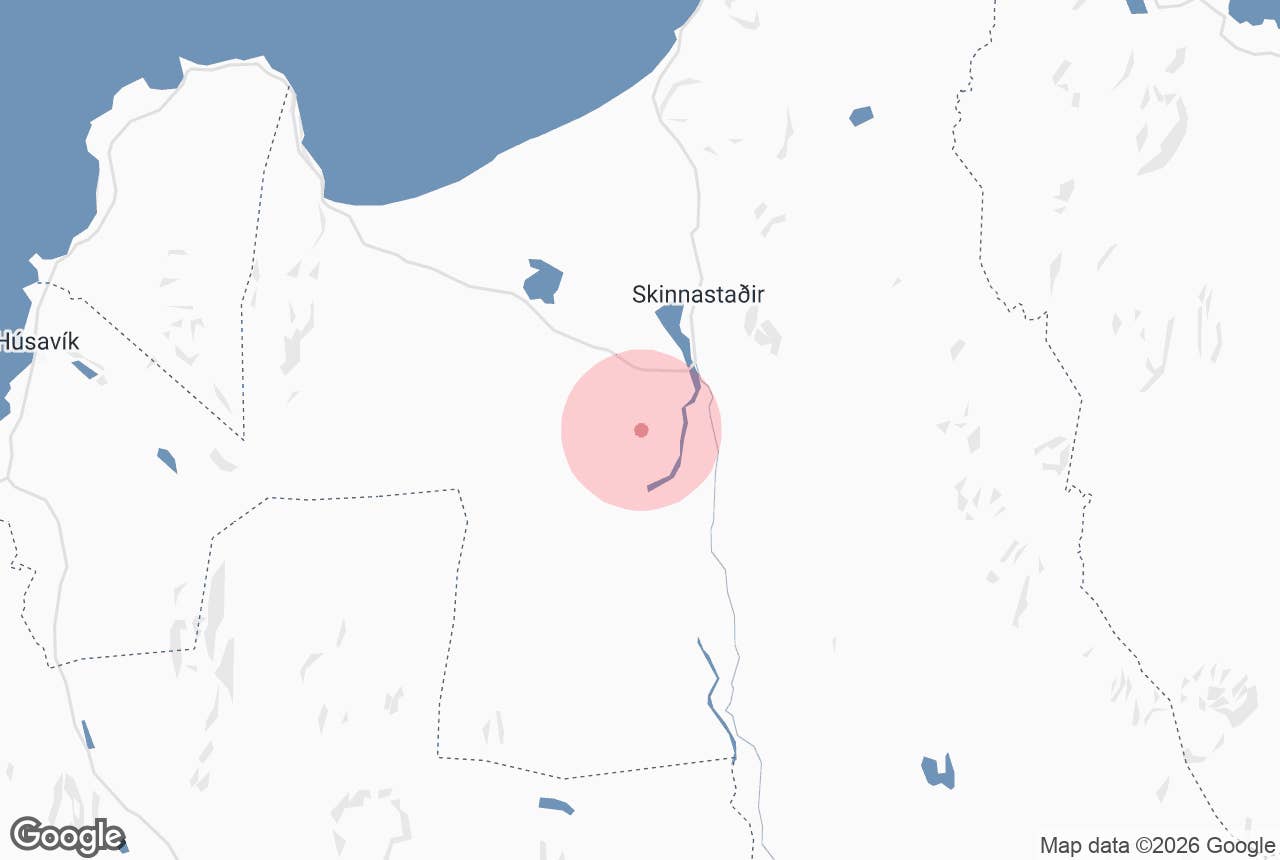
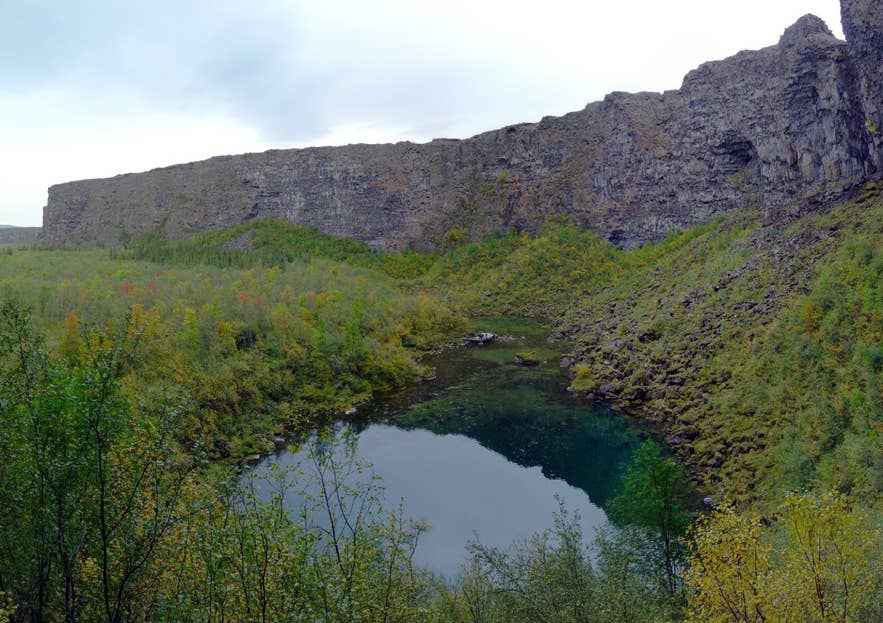
Botnstjörn at the head of Ásbyrgi. Photo: Spike, CC BY-SA 4.0
Botnstjörn ("the pond at the bottom") is the small, still lake at the innermost end of Ásbyrgi canyon in Vatnajökull National Park, North Iceland. It sits directly beneath the 100-metre cliffs that close the horseshoe of Ásbyrgi, about 38 kilometres east of Húsavík as the crow flies (65 km by road) and just off the Diamond Circle route.
Botnstjörn is the end point of the canyon's most popular short walk, and its combination of dark water, birch and willow woodland, ducks on the water and fulmars wheeling off the cliff above makes it the quietest and most sheltered spot in the whole canyon.
Key Takeaways About Botnstjörn
- Small pond beneath the 100 m cliffs at the innermost end of Ásbyrgi canyon
- The plunge pool left by the glacial floods that carved Ásbyrgi 8,000-10,000 and about 3,000 years ago
- Easy 1 km loop trail (about 30 minutes) from the inner car park to a viewing platform
- Ducks on the pond and fulmars breeding on the cliffs above; best birding late May to early July
- Free entry; 65 km from Húsavík and 32 km from Dettifoss on paved roads

Why visit Botnstjörn
Botnstjörn is the place where Ásbyrgi's story ends and, geologically, where it began. The canyon is about 3.5 kilometres long and 1.1 kilometres wide, its walls rising from 90 to 100 metres at the head, with the 250-metre-wide rock island Eyjan splitting the outer part in two.
The most widely accepted explanation is that it was carved by two catastrophic glacial outburst floods down the river Jökulsá á Fjöllum, the first 8,000 to 10,000 years ago and the second about 3,000 years ago.
When the floodwater poured over the lip of the lava plateau, an enormous waterfall stood exactly where Botnstjörn is today; the plunge pool it scoured is the pond. The river later returned to its present course a couple of kilometres to the east, leaving the canyon dry except for this one remnant of water.
The rock in the walls is layered shield lava from the Stóravíti crater on Þeistareykjabunga, erupted 11,000 to 12,000 years ago.
In folklore the canyon is Sleipnir's hoofprint, left when Óðinn's eight-legged horse touched the ground here, an idea put into verse by the poet Einar Benediktsson, who lived at the farm Ásbyrgi, in his poem "Sumarmorgunn í Ásbyrgi". In that image the rock island Eyjan is the mark of the frog of the hoof.
The pond is also the best wildlife spot in Ásbyrgi. Ducks such as wigeon gather on the water and waterfowl nest in the vegetation around it. Since about 1970 fulmars have colonised the cliff ledges and now breed there densely; you will hear them before you see them.
The surrounding woodland of native birch, willow and rowan, with pine, spruce and larch planted between 1947 and 1977, holds redwings, redpolls and wrens. The sheltered air at the canyon head is also noticeably warmer and calmer than on the open plain outside, which is why insects and wildflowers thrive here.

Botnstjörn below the Ásbyrgi cliffs. Photo: Hansueli Krapf, CC BY 2.5
How to get to Botnstjörn
Ásbyrgi lies on Route 85, about 65 kilometres (an hour) from Húsavík, 140 kilometres (just over two hours) from Akureyri via Route 1 and Route 85, and roughly 520 kilometres (seven to eight hours) from Reykjavík. From the west-bank Dettifoss car park it is about 32 kilometres north on Route 862. Route 85 is open year-round.
Turn in at the Gljúfrastofa visitor centre and campsite at the canyon mouth, then follow the access road about 3.5 kilometres along the canyon floor to the car park at the head of Ásbyrgi.
From there the signed trail (Á1) to Botnstjörn is a loop of about one kilometre on gravel and boardwalk, with a viewing platform above the pond, and is graded for limited mobility. Allow 30 minutes.
No 4x4 is needed; the access road may be closed by snow in winter, when you walk in from the visitor centre.
Best time to visit
Late May to early July is best for birds, when waterfowl are nesting and fulmars are busy on the ledges, and the birch is freshly in leaf.
July and August bring the most visitors and the warmest, calmest weather, so come early in the morning or in the evening for still water and reflections. September gives autumn colour in the birch and quieter paths.
In winter the canyon is open but the pond may be frozen and the access road may be closed.

Botnstjörn below the Ásbyrgi wall. Photo: Jerzy Strzelecki, CC BY-SA 4.0
Safety and practical tips
- Keep to the path and platform. The pond's edge is boggy and the slopes under the cliff are loose; rockfall from the 100-metre wall happens, especially during thaw.
- Do not approach nests or walk on the shore in May and June; waterfowl nest in the vegetation around the pond.
- The visitor centre Gljúfrastofa has toilets, an exhibition, information and a small souvenir shop (open year-round, daily in summer); there is no café in the canyon. The nearest fuel and food are at the Ásbyrgi service station and shop on Route 85 by the canyon mouth, and in Húsavík.
- Entry to Ásbyrgi is free. The campsite at the canyon mouth is open in summer and charges per person.
- Combine the pond with the Eyjan rim walk (4.5 km, about 1.5 to 2 hours) or the full canyon loop for a half-day; longer trails continue south to Hljóðaklettar and Dettifoss.
- Summer midges can be thick around the water on still days; bring a head net if you are sensitive.
Nearby attractions
- Ásbyrgi – the canyon itself, 2 km
- Gljúfrastofa - Ásbyrgi Visitor Centre – park information at the canyon mouth, 3.6 km
- Jökulsárgljúfur/Ásbyrgi campground – 3.2 km
- Hljóðaklettar – echo rocks in Vesturdalur, 7 km
- Vesturdalur Valley – 7 km
- Dettifoss – the Jökulsá á Fjöllum waterfall famous for its power, 21 km
- Húsavík – whale-watching town, 38 km
Tours that visit Botnstjörn
- Private 4-Day North Iceland Tour of Akureyri, Myvatn, and the Diamond Circle from Reykjavik – visits Ásbyrgi, where the itinerary points out the small lake Botnstjörn at the base of the cliffs.
- 10-Day Summer Vacation in Iceland with Flights from Reykjavik to Akureyri, Waterfalls & Hot Springs – the itinerary includes a visit to Botnstjörn during its Diamond Circle day.