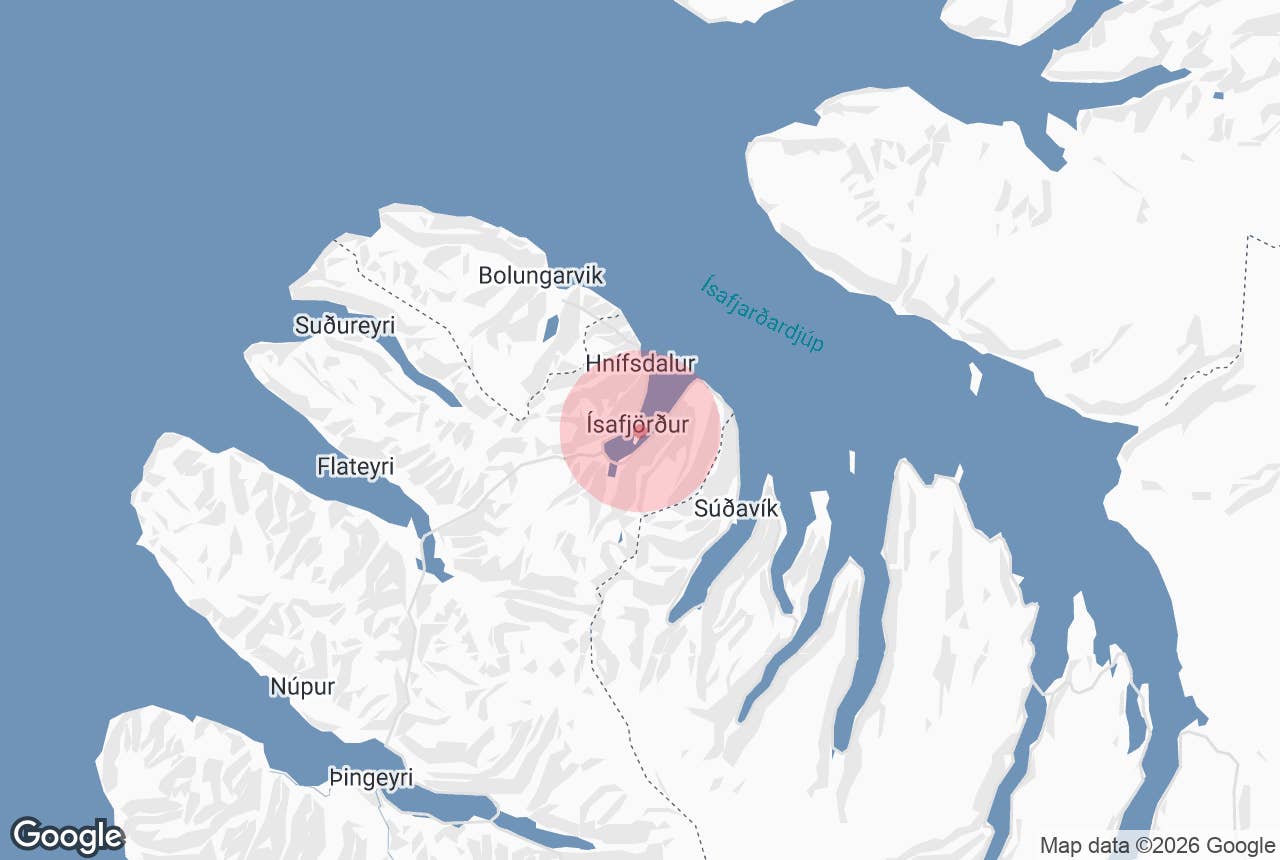
Edinborg Cultural Center (Edinborgarhúsið, "the Edinburgh House") is a protected 1907 timber warehouse turned arts centre on Aðalstræti in the middle of Ísafjörður, the largest town in Iceland's Westfjords.
It stands at the edge of Pollurinn, the sheltered inner harbour, and today holds concert and theatre halls, the Slunkaríki art gallery, an art school, a bistro and the offices of a local tour operator.
If there is a concert, play or exhibition on in Ísafjörður, it is probably here.
Key Takeaways About Edinborgarhúsið
- A 1907 timber-and-corrugated-iron warehouse of the Edinburgh Trading Company, designed by Rögnvaldur Ólafsson; exterior protected since 1999.
- Restored by a volunteer-founded company from 1992 and reopened as a cultural centre on its 100th birthday in 2007.
- Houses three halls, the Slunkaríki gallery, an art school and a bistro; most Ísafjörður concerts and theatre happen here.
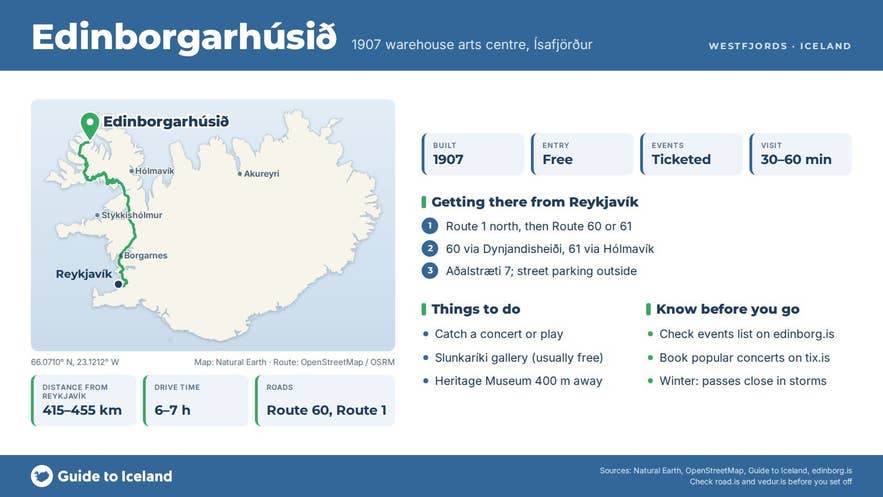
- Aðalstræti 7, 400 m from the Westfjords Heritage Museum; street parking; lift to all floors.
- Ísafjörður is 415 to 455 km (6 to 7 hours) from Reykjavík by Route 60 or 61, or a 40-minute flight.
Why visit Edinborg Cultural Center
The house owes its name to Scotland. Edinborgarverslun, the Edinburgh Trading Company, was founded in Reykjavík in 1895 by Ásgeir Sigurðsson, an Ísafjörður native, together with Copland & Berrie of Leith, the port of Edinburgh. By 1900 it was one of the largest trading firms in Iceland.
It opened a shop in Ísafjörður in 1902 and in April 1907 was granted a plot on Pollurinn for a warehouse and pier. The building was designed by Rögnvaldur Ólafsson, often described as Iceland's first architect, and raised by his brother Jón Þ. Ólafsson, the master builder; the house was up by 7 December 1907.
At 42 m long and 12.65 m wide over two floors, clad in corrugated iron with brackets under the eaves and two-storey corner towers at the back, it was for decades one of the largest structures in Ísafjörður.
Its working life traces the town's economy. Edinborgarverslun pulled out in 1917 and its manager Karl Olgeirsson carried on the trade. From 1925 the house was home to Togarafélag Ísfirðinga, the company that ran the trawler Hávarður Ísfirðingur until the Depression bankrupted it.
In 1937 the Ísafjörður cooperative, Kaupfélag Ísfirðinga, bought the property and processed fish here, adding an indoor drying room after 1945. The cooperative owned the house for more than 50 years. By the late 20th century it stood empty.
On 9 September 1992 a group from Ísafjörður's arts community founded Edinborgarhúsið ehf., bought the building and began restoring it, largely with volunteer labour.
The exterior was placed under heritage protection in December 1999, and a 2006 agreement between the state and the town funded the final rebuild as one of Ísafjörður's three culture houses. The house reopened on its 100th birthday in 2007.
Inside today you will find Edinborgarsalur, the 221 m² main hall on the ground floor used for concerts, theatre and conferences; Bryggjusalur, a bright 119 m² side hall seating around 100 that doubles as exhibition space; and Rögnvaldarsalur, a 70 m² room upstairs.
The Slunkaríki gallery, run for most of its life by the Ísafjörður Visual Artists' Association, has staged more than 200 exhibitions and now occupies the ground-floor corridor and Bryggjusalur, with shows by Westfjords and visiting artists.
The Rögnvaldur Ólafsson Art School, founded in 1993 and based in the house since 1999, teaches music, visual and performing arts. The Vesturferðir travel agency also has its office in the house, and Edinborg Bístró serves meals here.
How to get to Edinborg Cultural Center
The address is Aðalstræti 7, 400 Ísafjörður, on the town's main street, 400 m from the Westfjords Heritage Museum at Neðstikaupstaður and a short walk from the harbour, the church and the swimming pool. There is street parking outside. All doors are wide enough for wheelchairs (they are not automatic) and a lift connects every floor.
Ísafjörður is a long way from Reykjavík: 415 to 455 km by road depending on the route, which means six to seven hours of driving.
The two options are Route 60 (Vestfjarðavegur) through Dynjandisheiði and the Dýrafjörður tunnel, which passes Dynjandi waterfall, or Route 61 (Djúpvegur) via Hólmavík and around Ísafjarðardjúp. From Hólmavík the Djúpvegur leg alone is about 224 km and three hours.
Both routes are open to ordinary cars in summer and no 4x4 is needed, but the mountain passes close during winter storms; check umferdin.is before driving.
The fastest way in is the roughly 40-minute flight from Reykjavík Domestic Airport to Ísafjörður Airport, a few kilometres across the fjord from the house.
Best time to visit
The building can be admired from outside at any time, and the gallery and bistro keep daytime hours, but Edinborgarhúsið is really about what is on. Summer brings the fullest programme and the cruise-ship crowds; in the dark months locals rely on the house for concerts and theatre. Check the events list on edinborg.is before you arrive.
Safety and practical tips
- Many events are ticketed; buy in advance through the venue or tix.is for popular concerts.
- The bistro's operator has changed over the years (a new operator was being sought in mid-2026), so confirm it is open before planning a meal.
- Exhibitions in Slunkaríki are usually free.
- Contact: edinborg@edinborg.is. The house is run by a private company, Edinborgarhúsið ehf., and the halls can be hired for private events.
- In winter, allow extra time for weather on the roads in and out of Ísafjörður, and keep an eye on avalanche-warning closures.
Nearby attractions
- Westfjords Heritage Museum – 0.4 km
- Tjöruhúsið – 0.4 km, the fish restaurant in an 18th-century warehouse
- Ísafjarðarkirkja – 0.5 km
- Isafjordur Culture House – 0.6 km, library and archives in the old hospital
- Naustahvilft Troll Seat – 1.3 km, the hike to the bowl above the airport
- Tungudalur – 4 km, valley with waterfall and ski area
- Sudavik Arctic Fox Center – 7.4 km
- Bolungarvík – 11 km
Tours that visit Edinborg Cultural Center
- 10-Day Summer Self-Drive Tour of Iceland's Full Ring Road with Westfjords and Snaefellsnes Peninsula – the Westfjords leg of this self-drive itinerary stops in Ísafjörður and suggests dropping into Edinborgarhúsið for local art.