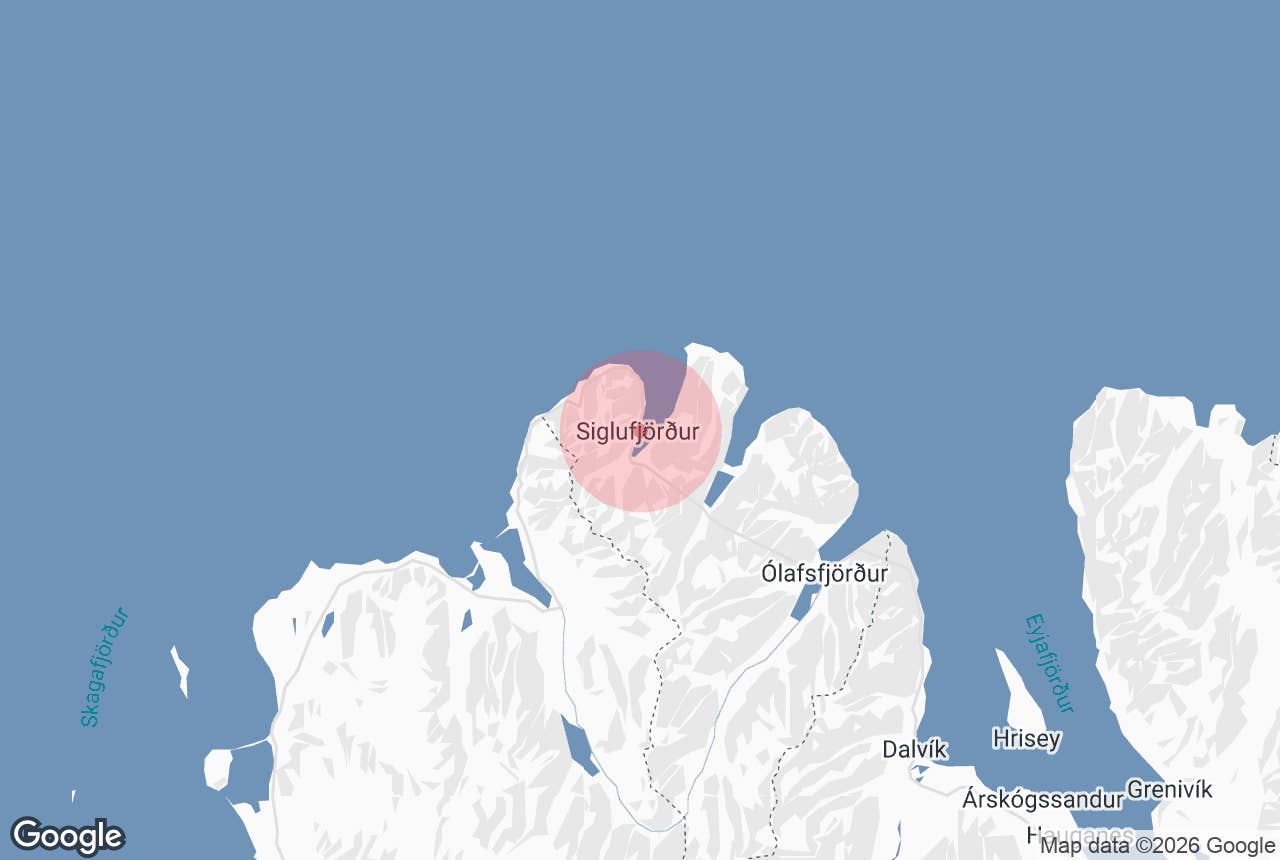
The Folk Music Centre in Siglufjörður (Þjóðlagasetur séra Bjarna Þorsteinssonar, usually shortened to Þjóðlagasetrið, "the folk-music centre") is a small museum devoted to Iceland's traditional music: rímur chanting, two-part tvísöngur singing, lullabies, hymns and the home-made instruments people played before pianos and accordions reached the country.
It occupies Maðdömuhúsið ("the Madame's House"), one of the oldest buildings in Siglufjörður, a herring town at the northern tip of the Tröllaskagi peninsula in North Iceland. The centre is named after the Reverend Bjarni Þorsteinsson, who lived in this house from 1888 to 1898 and spent his life collecting the songs the museum now plays.
Key Takeaways About Þjóðlagasetur séra Bjarna Þorsteinssonar
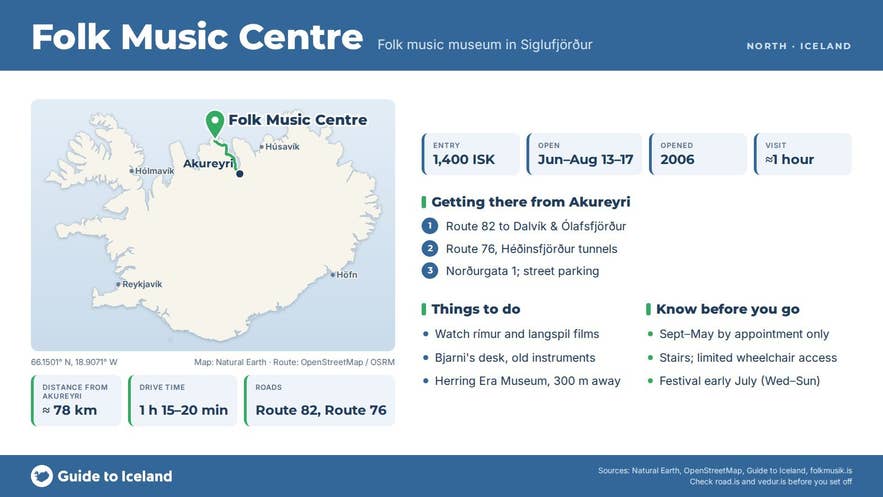
- Museum of Icelandic folk music in Maðdömuhúsið, Norðurgata 1, Siglufjörður; opened in July 2006, 100 years after the first part of Íslensk þjóðlög appeared
- Films of rímur chanting, tvísöngur, þulur, langspil and fiðla playing, plus Bjarni Þorsteinsson's writing desk and other items connected with him
- Open daily 1 June–31 August, 13:00–17:00; by appointment September–May (contact the centre in advance)
- Adults 1,400 ISK, concessions 900 ISK, under 16 free (2026 prices)
- The centre runs the Siglufjörður Folk Music Festival in early July (Wednesday to Sunday); the Herring Era Museum is 300 m away
Why visit the Folk Music Centre
Bjarni Þorsteinsson (1861–1938) was Iceland's foremost collector of folk music. He began writing down songs around 1880 and, with support from the Carlsberg Foundation in Denmark, published Íslensk þjóðlög ("Icelandic Folk Songs") in Copenhagen in 1906–1909, a collection of hundreds of melodies, some transcribed directly from singers around the country and others sent in by fellow collectors.
He was also a composer, and served Siglufjörður as both priest and local politician for so long that he is often called the father of the town. The Folk Music Centre opened in July 2006, timed to the 100th anniversary of the book's first volume.
The exhibition is built around sound and film rather than glass cases. Screens show Icelanders of all ages chanting rímur (epic verse), singing tvísöngur in parallel fifths, reciting nursery rhymes and þulur, and playing the langspil, a long box zither related to the dulcimer, and the fiðla, the bowed Icelandic fiddle.
Much of this footage was collected by Gunnsteinn Ólafsson with the filmmaker Dúi Landmark between 2005 and 2024; the centre also shows films made around Iceland in 1992 by the Danish ethnomusicologist Svend Nielsen with Helga Jóhannsdóttir and Jón Samsonarson.
The full archive can be browsed on computers in the North Loft upstairs, and the parlour holds items connected with Bjarni, such as his writing desk and portrait, alongside Icelandic instruments. In 2012 the centre received a special award from the Minister of Education and Culture on Icelandic Language Day for its work on the national heritage.
The centre also runs the Siglufjörður Folk Music Festival (Þjóðlagahátíðin á Siglufirði) every year in early July, running from Wednesday to Sunday, with concerts in Siglufjörður Church, the Herring Era Museum's Boat House and local cafés, plus courses in singing, dancing and traditional instruments. The 2026 festival ran 1–5 July; the 2027 edition is set for 7–11 July.
How to get to the Folk Music Centre
The address is Norðurgata 1, 580 Siglufjörður, in the town centre, about 300 m from the harbour and the Herring Era Museum. Street parking nearby is normally free, but check the signs.
From Reykjavík it is roughly 385 km and about 5.5 to 6 hours of driving: follow the Ring Road (Route 1) north into Skagafjörður, then Route 76 along the east side of the fjord through Hofsós and the Fljót district, and finally through the single-lane Strákagöng tunnel into Siglufjörður.
From Akureyri it is about 78 km and 1 hour 15–20 minutes: Route 82 to Dalvík and Ólafsfjörður, then Route 76 through the Héðinsfjarðargöng tunnels, which opened in 2010 and turned Siglufjörður from a dead end into part of the Tröllaskagi loop. Dalvík is about 35 km away.
All of these are paved roads with no 4x4 requirement, but Siglufjörður sits in heavy snow country and the approach roads can close in winter storms; check umferdin.is before setting out between November and April.
Best time to visit
The centre is open daily in summer, from 1 June to 31 August, 13:00–17:00. The best week of all is festival week in early July, when the exhibition is complemented by live concerts every evening and courses during the day.
From September to May the centre opens by appointment only, which works well for groups: contact the centre through its website (folkmusik.is) a few days ahead.
Safety and practical tips
- Admission (as published by the centre in 2026): adults 1,400 ISK; students and seniors 900 ISK; children under 16 free. Groups of eight or more pay 1,200 ISK per person, plus 8,000 ISK for a guided tour. A special opening outside normal hours costs 5,000 ISK per person.
- Allow about an hour; longer if you sit through the films.
- Maðdömuhúsið is a small, old timber house with stairs, so access for wheelchairs is limited.
- Siglufjörður has a swimming pool, cafés, a supermarket, fuel and accommodation. Pair the centre with the Herring Era Museum, Iceland's largest maritime museum, a three-minute walk away.
- Winter visitors should carry warm layers; the town is among the snowiest in Iceland and the avalanche-defence walls above it are part of the view.
Nearby attractions
- Siglufjörður – 0.2 km, the town itself
- Herring Era Museum – 0.3 km
- Strákagöng – 3.9 km, the 1967 tunnel on the western approach
- Héðinsfjörður – 7 km, the uninhabited fjord between the tunnels
- Ólafsfjörður – 14 km
- Dalvík – 26.5 km
Tours that visit the Folk Music Centre
- Relaxed 13-Day Summer Self-Drive Tour of the Ring Road with Snaefellsnes & the Westfjords – the North Iceland leg of this self-drive itinerary passes through Siglufjörður, where the Folk Music Centre (called the Folk Music Museum in the itinerary) and the Herring Era Museum are suggested stops.
- Relaxed 14-Day Self-Drive Tour of the Ring Road of Iceland & the Westfjords - a multi-day package whose itinerary includes this place.