

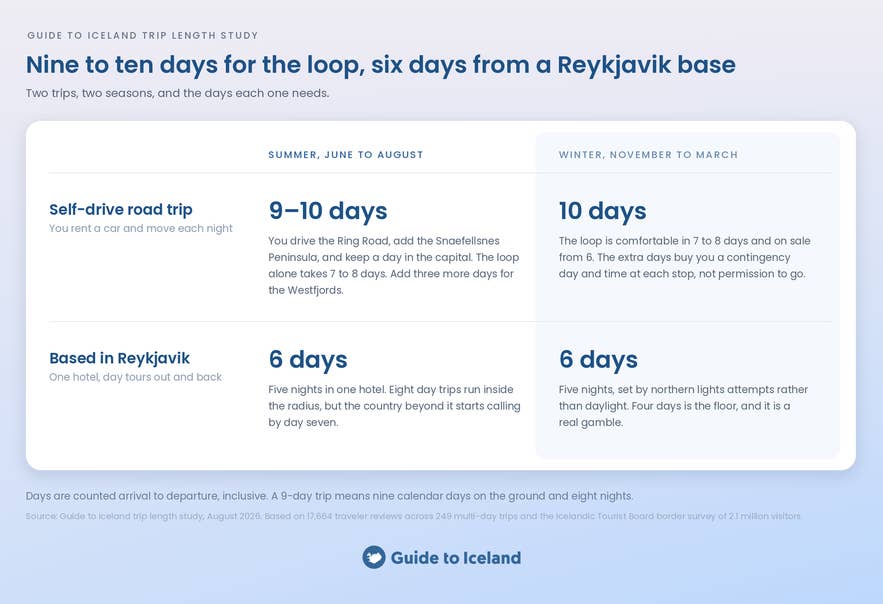
This study identifies how many days you need in Iceland by analyzing 17,664 traveler reviews across 249 multi-day trips and a national survey of departing visitors representing 2.1 million departures. It reveals how many nights you need to explore each region, see the northern lights, and understand how much an extra day in Iceland could cost.
The number of nights you book is the first planning decision you make when visiting Iceland. Your ideal trip length depends on whether you want to stay in hotels in Reykjavik and explore the surrounding area on day trips, or whether the entire Ring Road is realistic on self-drive tours.
Ask ten Icelanders how long you should stay, and you’ll get ten answers, most of them starting with “well, it depends on whether you’re driving.” They’re right, but that’s not much use when you’re booking flights to Iceland. So we went and measured it.
Why You Can Trust Our Content
Guide to Iceland is the most trusted travel platform in Iceland, helping millions of visitors each year. All our content is written and reviewed by local experts who are deeply familiar with Iceland. You can count on us for accurate, up-to-date, and trustworthy travel advice.
Guide to Iceland analyzed 17,664 traveler reviews across 249 multi-day trips on four booking marketplaces, the Icelandic Tourist Board’s border survey, and the full length of the Ring Road, to find the trip duration that leaves people satisfied rather than exhausted.
Keep reading for the full breakdown of length-of-stay data and the two trip lengths the evidence lands on.
Key Findings
-
Nine to ten days is the ideal length for a self-drive trip in Iceland in summer, while ten days is better in winter. The Ring Road itself can be driven in seven to eight days, with six-day Iceland itineraries available in both seasons.
-
Six days is ideal for an Iceland trip based in Reykjavik, in either summer or winter. This means five nights, four full touring days and two half days. In winter, four days is the practical minimum for an Iceland trip, and three aurora nights make it a real gamble.
-
Five nights in Iceland gives a strong chance of seeing the northern lights. The modeled chance rises from 58 to 83% after three nights and to 76 to 95% after five, with little additional gain by night seven.
-
Trip length does not affect traveler ratings. Across 150 rated Guide to Iceland trips with 11,175 reviews, the correlation between trip length and rating is just 0.03.
-
Visitors who reach farther regions stay longer on average. According to the Icelandic Tourist Board’s border survey, travelers who reached East Iceland stayed 9.9 nights, North Iceland 9.7, Westfjords 9.6, and the capital region 7.2.
-
North Iceland, the Westfjords, and East Iceland are the regions travelers most want to revisit, but they are also among the least visited. Among departing visitors, 61.2% named North Iceland, 54.2% the Westfjords, and 44.5% East Iceland, while only 15.9% actually reached the Westfjords.
-
Nationality changes Iceland trip length more than season does. German visitors average 8.8 nights, 4.9 for British visitors, and 6.1 for Americans. Markets averaging 6.4 nights or fewer are 48.9% of everyone who comes to Iceland.
Cite This Study
The charts and data in this study are free to use under CC BY 4.0. Credit Guide to Iceland and link to this page. Every chart has an Embed button underneath it with ready-to-paste code.
Overview: How Many Days Do You Need in Iceland
 You need nine to ten days to drive Iceland’s Ring Road in summer (June to August), and around ten days in winter (November to March). Six days is enough if you base yourself in Reykjavik, regardless of the season in Iceland.
The length of self-drive itineraries in Iceland is measured in calendar days, counted from arrival to departure. A nine-day trip in Iceland means eight nights.
If you only remember one thing, make it this: the number of days you need in Iceland isn’t how long you stay; it’s whether the trip you’ve planned fits inside it. Almost every complaint we found came from a good length attached to the wrong route.
How Many Days Do You Need To Drive Iceland’s Ring Road?
You need seven to eight days to drive Iceland’s Ring Road. Once you add the Snaefellsnes Peninsula and a day in Reykjavik, a full Ring Road trip takes nine to ten days in summer and ten days in winter.
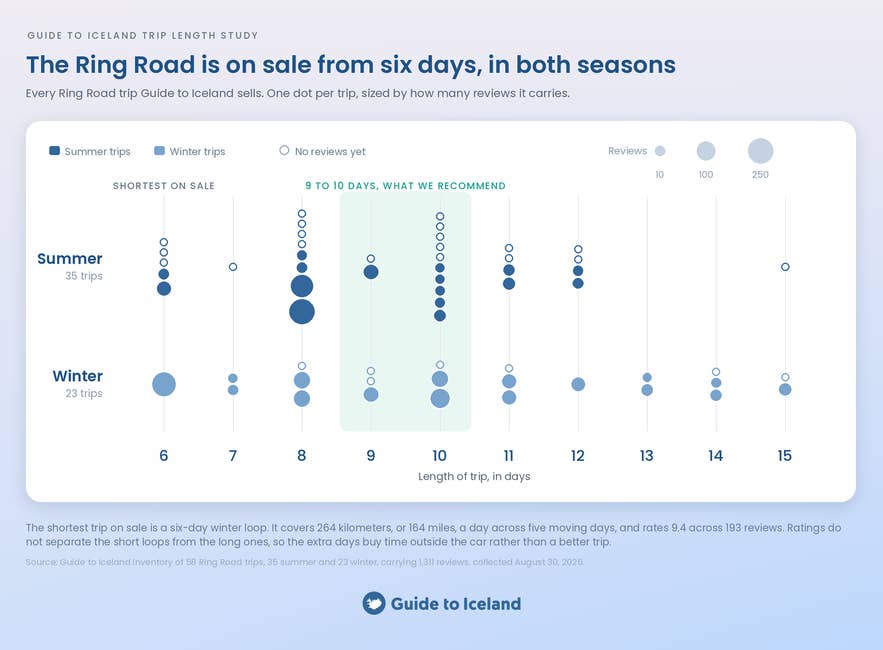
The Ring Road is 821 miles (1,322 kilometers) long. Guide to Iceland offers complete loops from six days in both summer and winter, and traveler reviews show that six-day trips receive ratings just as high as ten-day itineraries.
So the right length for a Ring Road trip depends on how much time you want to spend driving each day and how much time you want to spend at the attractions along the Ring Road.
These three self-drive tours show how the same Ring Road trip changes with the amount of time you give it:
-
7-Day Self-Drive Tour of the Complete Ring Road. The shortest way to complete the loop in summer, with longer driving days and less time at individual stops.
-
8-Day Self-Drive Tour of the Ring Road. The length most travelers book for a balanced option, giving you an extra day to spend less time in the car.
-
10-Day Self-Drive Tour with the Snaefellsnes Peninsula. The unhurried way to drive the Ring Road, with a detour to the Snaefellsnes Peninsula.
Add three more days to your itinerary in Iceland if you want to include the Westfjords. The best Westfjords itineraries cover the routes through that region. You can also browse the full range of self-drive tours in Iceland by length.
If you are planning your own itinerary rather than following a set tour, our day-by-day guides cover 6 days, 7 days, 8 days, 9 days, and 10 days in Iceland. The top road trips in Iceland cover the routes in detail. If this is your first trip to Iceland, our first-time visitor guide covers the planning tips you need to get started.
How Many Days Do You Need To Stay in Reykjavik?
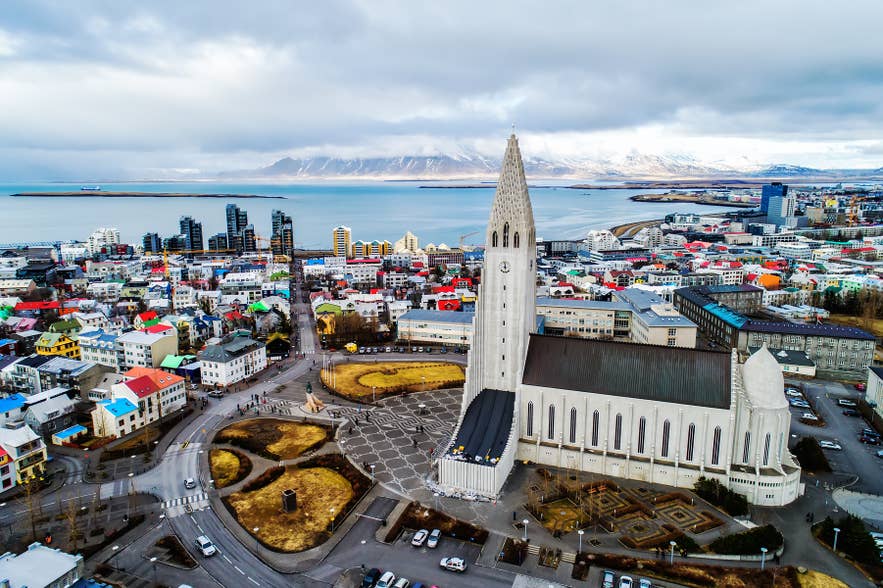
Six days and five nights is the ideal length for an Iceland trip based in Reykjavik and built around day tours and multi-day tours. Four days in Iceland is the minimum for a Reykjavik-based trip, but it leaves little room for delays, bad weather, or changes to your itinerary.
With fewer days, you will have to choose between the top things to do in Iceland rather than combining several day trips from Reykjavik.
The geography of Iceland limits how far you can reasonably travel on a day tour from Reykjavik. Comfortable day trips from Reykjavik reach about 112 to 124 miles (180 to 200 kilometers) one way.
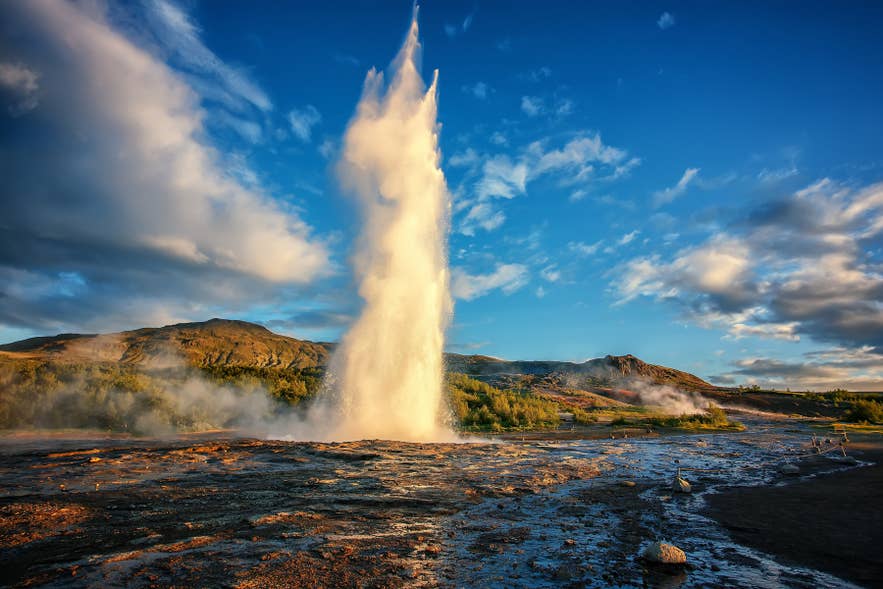
The distance from Reykjavik helps explain why six days works well for a city-based Iceland itinerary. Vik is 116 miles (187 kilometers) from Reykjavik, while Arnarstapi on the Snaefellsnes Peninsula is 119 miles (192 kilometers) away. Both are within the range of destinations that can be visited on a long day tour.
Jokulsarlon Glacier Lagoon, by comparison, is 236 miles (380 kilometers) from Reykjavik, roughly twice as far. A day tour to Jokulsarlon can take 14 to 16 hours, leaving only around 60 to 90 minutes at the glacier lagoon itself.
Icelandic Tourist Board data shows a similar pattern in visitor distribution. Regions within roughly 112 to 124 miles (180 to 200 kilometers) of the capital region receive 50% to 88% of visitors, compared with 16% to 35% for regions farther away.
Here’s how six days actually fill up:
-
Arrival: Keflavik Airport is 50 minutes from Reykjavik, so Blue Lagoon excursions or Reykjanes Peninsula tours can work well on your arrival day if your flight schedule allows.
-
Day 1: Spend your first day on Golden Circle adventures. Most tours take six to eight hours, while adding an activity such as Silfra snorkeling can extend the day to around ten hours.
-
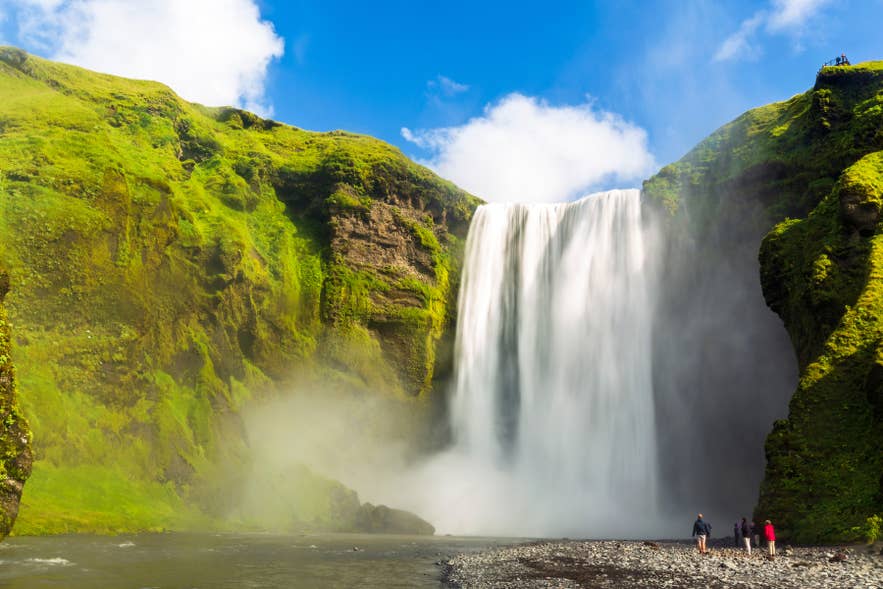
Day 2: The South Coast tours to sights including Skogafoss Waterfall, Seljalandsfoss Waterfall, and Reynisfjara Black Sand Beach generally take eight to ten hours.
-
Day 3: In summer, Snaefellsnes Peninsula excursions take 10 to 12 hours and visit highlights such as Kirkjufell Mountain. In winter, you can instead dedicate the day to ice cave tours.
-
Day 4: Jokulsarlon Glacier Lagoon tours make for a long day trip from Reykjavik, while the Highland adventures are another option in summer.
-
Departure: Use your remaining time to see Reykjavik before your flight. Reykjavik walking tours are an easy way to see the city’s main sights in a few hours.
A six-day itinerary gives you four days for sightseeing and day tours. If you extend your stay to seven days, you can add activities such as whale-watching activities or Westman Islands tours. Beyond that, a self-drive trip becomes a more efficient way to reach destinations outside the day trip range.
For more options, browse day tours from Reykjavik and tour destinations in Iceland. For shorter trips, see guides to a weekend in Iceland, 3 days, 4 days, and 5 days in Iceland. If you are only connecting through Iceland, read our guide on what to do during a stopover.
Do Longer Trips in Iceland Get Better Reviews?
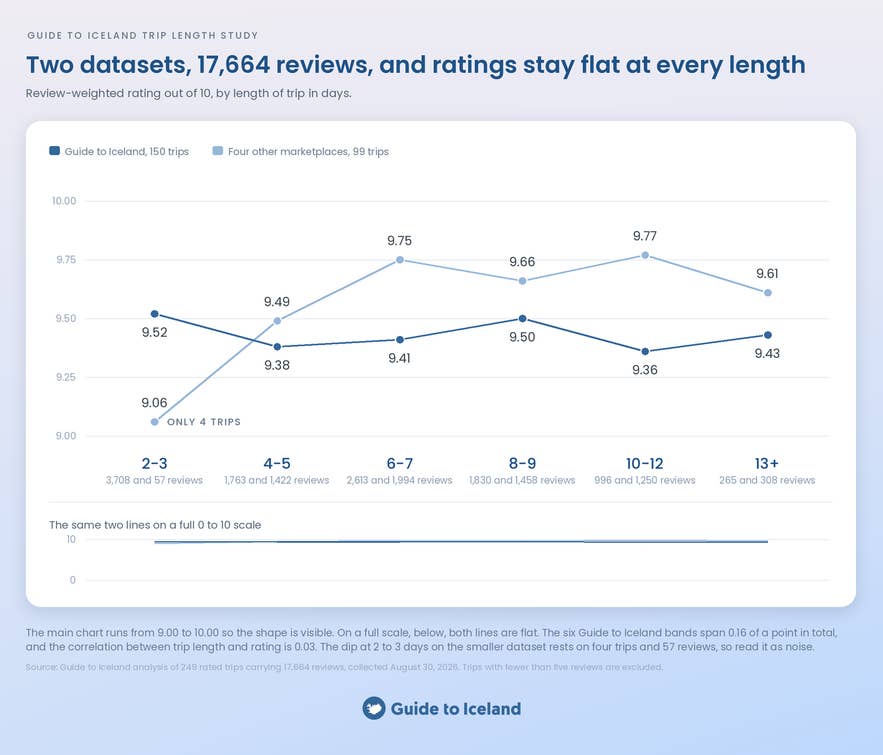
Longer trips in Iceland do not get better reviews. Across 150 rated Guide to Iceland trips carrying 11,175 reviews, the correlation between trip length and rating is 0.03, statistically indistinguishable from zero. In other words, trip length in Iceland has no relationship with how travelers rate their Iceland trips.
We group the trips into duration bands, and every band lands between 9.36 and 9.52 out of 10. Whether an Iceland trip lasts two days or two weeks, the average rating changes by just 0.16 points.
Across four independent marketplaces we checked (Nordic Visitor, TourRadar, Arctic Adventures, and Intrepid), ratings show a weak positive relationship with trip length. However, the result is too small to be reliable, because the two- to three-day sample contains only four trips and 57 reviews.
Guide to Iceland’s own data provides a much stronger sample for short trips. The two-to-three-day group contains 26 trips and 3,708 reviews, more than 60 times the number of reviews behind the external two-to-three-day sample. It is also the highest-rated of the six trip-length groups.
Why Doesn’t Trip Length Affect Iceland Trip Ratings?
Trip length does not determine whether an Iceland trip receives a good rating because tour operators in Iceland design itineraries around the time available. A well-planned three-day trip can deliver a highly rated experience just as a well-planned 12-day trip can.
A rating measures whether a trip delivered a good experience, not whether the trip was the right length. That means trip ratings tell you whether an itinerary works, but not how many days you need in Iceland.
To determine the ideal length of an Iceland trip, you need to look at different factors: what travelers actually visit, how far they can reasonably drive, the time required between destinations, and how much daylight is available in each season.
How Many Nights Do You Need for Each Region of Iceland?
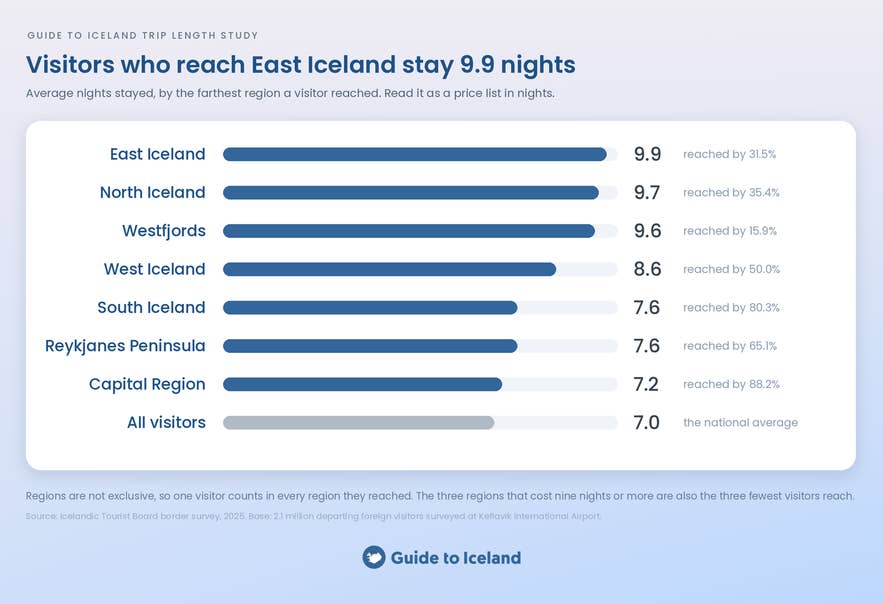
According to the survey, travelers who made it to East Iceland averaged 9.9 nights, followed by North Iceland at 9.7 nights, and the Westfjords at 9.6 nights. The averages were 8.6 nights for West Iceland, 7.6 nights for South Iceland and the Reykjanes Peninsula, and 7.2 nights for visitors who remained in the Capital Region.
The graph shows the average length of stay in Iceland reported by visitors who reached each region. These numbers should not be treated as recommended trip lengths for each region.
The same Icelandic Tourist Board survey also asks departing visitors which regions they would like to visit if they returned to Iceland. North Iceland ranked first at 61.2%, followed by the Westfjords at 54.2% and East Iceland at 44.5%.
These three regions in Iceland also have some of the longest average visitor stays and relatively low reach among survey respondents. North Iceland was reached by 35.4% of visitors, East Iceland by 31.5%, and the Westfjords by just 15.9%.
The pattern suggests that time is a major constraint: the regions travelers most want to see are also among those that fewer visitors reach, largely because they require longer trips.
How Many Days in Iceland in Winter vs. Summer?
You need around nine to ten days for a comfortable Ring Road trip in summer and about ten days in winter. If you base yourself in Reykjavik, six days gives you enough time to see several major sights without driving the full loop.
The main difference between the seasons is how many hours you can be outside. Daylight affects how much you can see, how long you can spend at each stop, and how much margin you have when plans change.
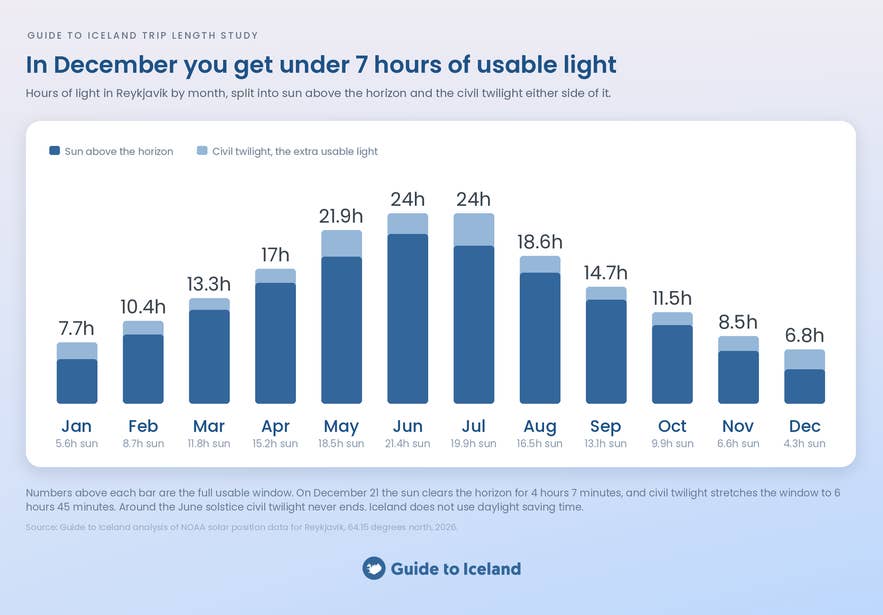
On December 21, 2026, Reykjavik has just four hours and seven minutes of daylight. That number sounds more restrictive than it is, because the sun does not need to be above the horizon for outdoor activities in Iceland.
Civil twilight provides usable natural light before sunrise and after sunset. Including civil twilight, Reykjavik has about 6 hours and 45 minutes of workable light on the winter solstice.
The month-by-month daylight pattern in Reykjavik shows important differences between summer and winter:
-
June and July never become fully dark in Reykjavik. Civil twilight lasts throughout the night around the summer solstice, creating the conditions for the midnight sun.
-
March and September have more than 13 hours of usable daylight. These shoulder-season months sit much closer to summer than to winter.
-
October and February give you around 10 to 11 hours. Both offer noticeably more room than mid-winter, which makes either month workable for a Ring Road trip.
-
December has roughly a quarter as much usable daylight as June. This does not prevent a Ring Road trip, but it requires shorter driving days and more planning.
How Far Can You Drive in Iceland Each Day?
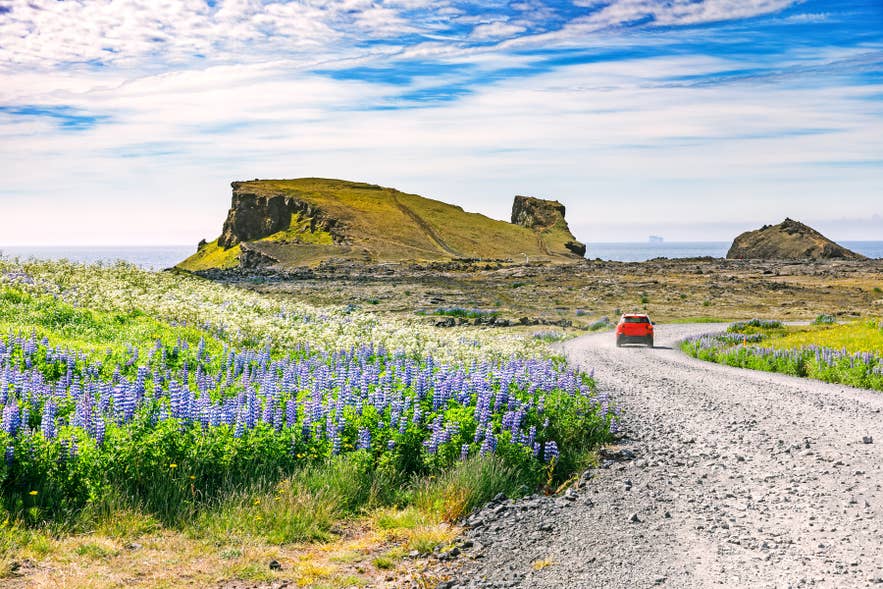
Travelers who have driven Iceland in both seasons agree on a comfortable pace: about 174 miles (280 kilometers) a day in summer before it starts feeling like a car journey, and 93 to 124 miles (150 to 200 kilometers) a day of driving in Iceland in winter.
These are comfortable travel distances, not hard limits. You can drive farther when conditions are good, but longer distances leave less time for stops and less margin if weather or road conditions in Iceland change.
We looked at all 58 Ring Road trips currently sold by Guide to Iceland and plotted them by duration. Six-day loops are available in both summer and winter, making six days the shortest duration on sale.
Those short winter trips are not a compromise. A six-day Ring Road trip works out at 164 miles (264 kilometers) a day across five moving days, and it rates 9.4 out of 10 across 193 reviews.
Six days is still not the ideal length for driving the Ring Road. The existence of a six-day winter itinerary shows only that limited daylight does not make a six-day Ring Road trip impossible.
Why Do You Need More Flexibility for a Winter Ring Road Trip?
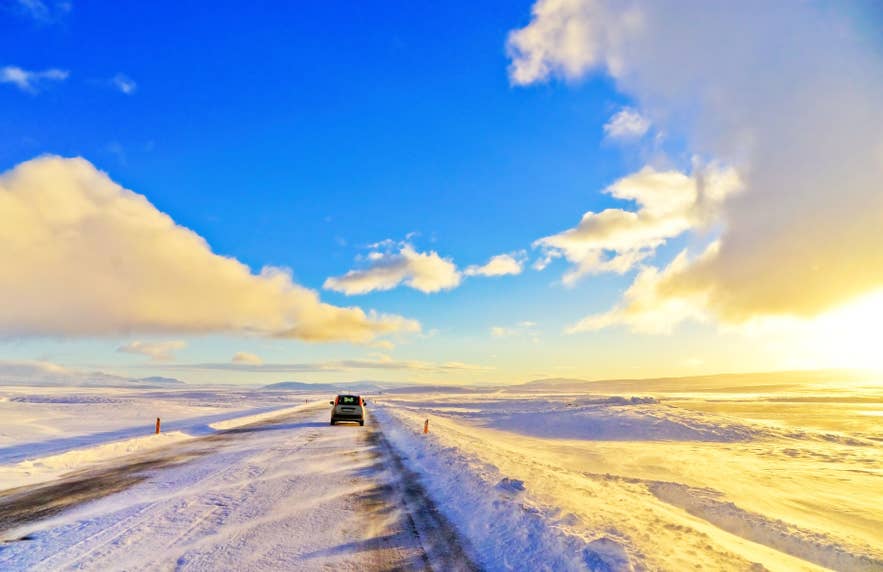
According to the Icelandic Met Office, there have been roughly 380 weather warnings in Iceland per year since 2018. The Ring Road’s recurring disruption points, Reynisfjall Mountain at Vik and Oxnadalsheidi Mountain Pass west of Akureyri, sit on the main loop.
A single road closure in Iceland can cost you a morning or force you to change your route. An extra day in winter gives you a buffer when roads or weather disrupt your plans. A 4x4 vehicle offers greater capability in winter conditions, but it can’t prevent weather-related delays.
What Sets the Limit in Summer in Iceland?
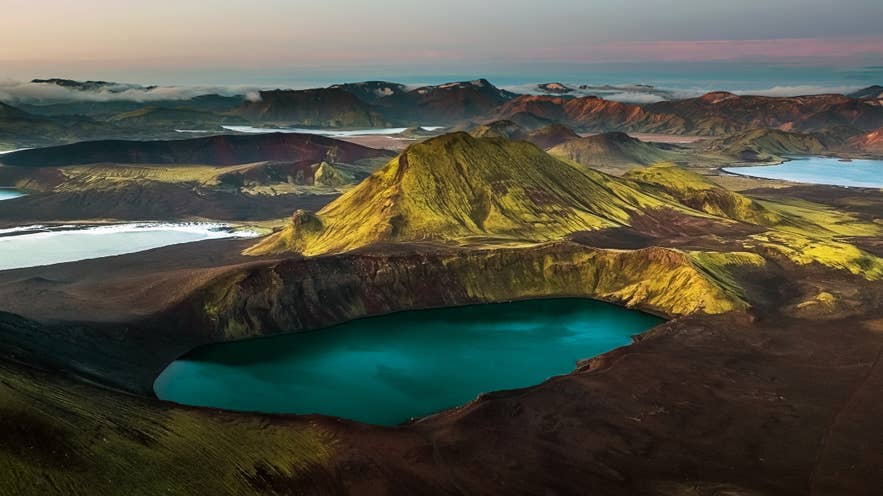
Summer removes the daylight limit, but some activities are still limited by seasonal access. If the Highland F-roads are on your itinerary, their seasonal opening dates (from late May to mid-July) can determine when you travel.
For the month-by-month picture, see when is the best time to visit Iceland, our ultimate winter itinerary, and Iceland’s climate and weather.
How Many Nights Do You Need To See the Northern Lights in Iceland?
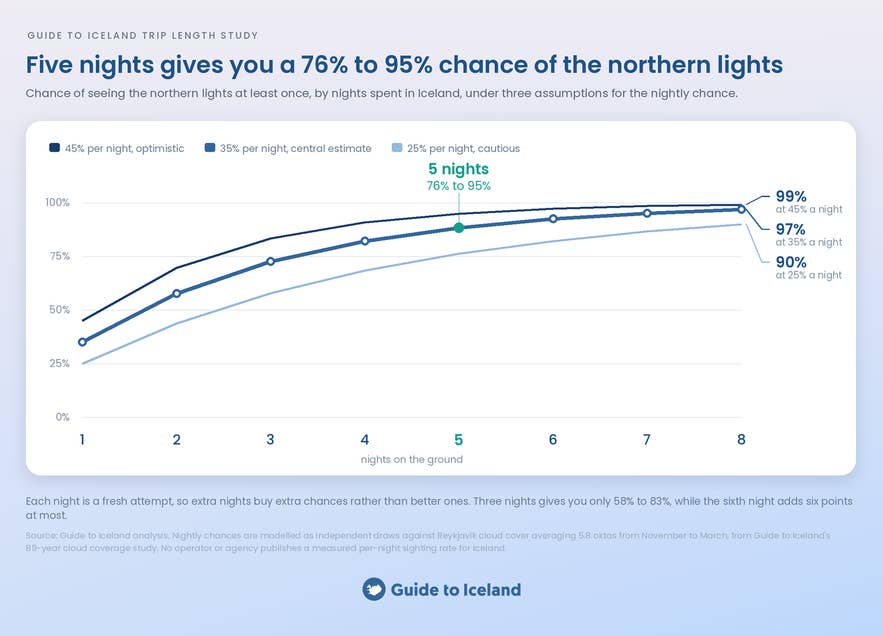
Five nights gives you a strong chance of seeing the northern lights in Iceland. Three nights in Iceland is more of a gamble, while adding a seventh night does not improve your overall odds.
Based on our model, three nights give you a 58% to 83% chance of seeing the northern lights at least once, while five nights increase the cumulative chance to 76% to 95%. A seventh night adds no more than five percentage points, showing why the benefit of each additional night decreases over time.
Each night is an independent draw against Iceland’s cloud cover, which averages 5.8 oktas over Reykjavik from November to March, a figure from our own 89-year study of Icelandic cloud coverage. That makes the cumulative-chance curve steep at first and flat later.
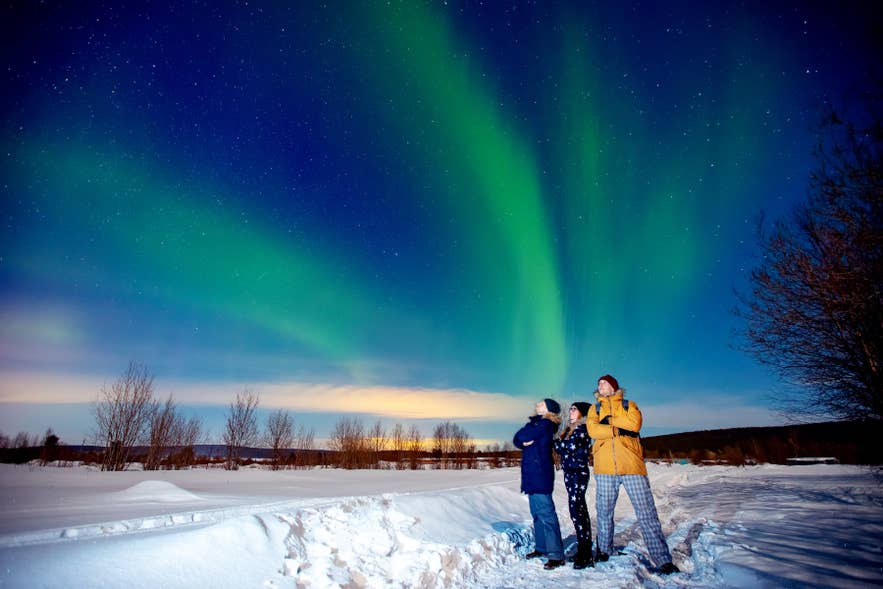
The percentages above are modeled estimates, not measured aurora sighting rates. No tour operator or agency publishes a verified per-night probability of seeing the northern lights.
Our 95-year study of the Kp index found that location matters around six times more than the month you choose. Picking December over February changes your odds far less than picking a dark location. Staying at a northern lights hotel away from Reykjavik’s light pollution does more for your chances than adding a night to your trip.
For practical advice, read our guide on how to find the northern lights in Iceland. You can also browse our northern lights tours if you prefer a guide who tracks the aurora forecast for you.
How Much Does an Extra Day in Iceland Cost?
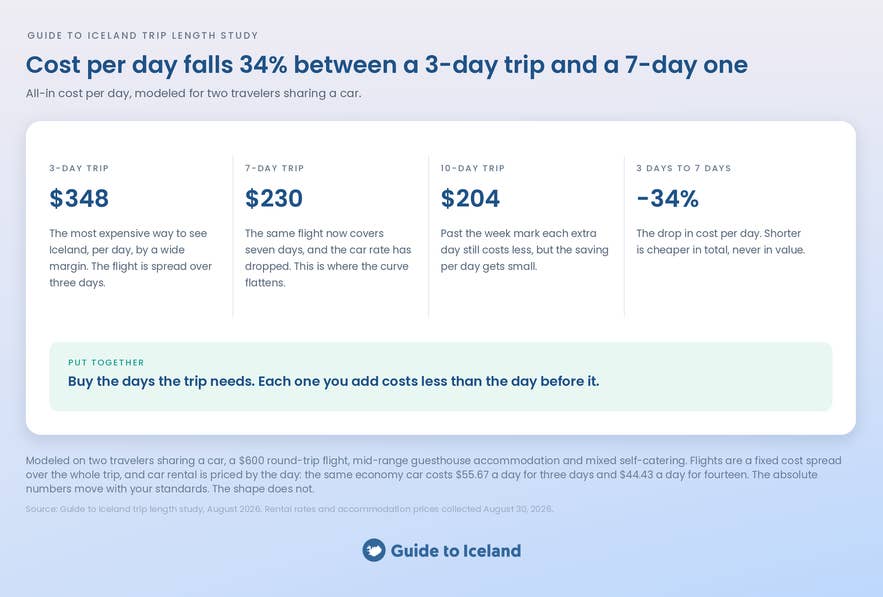
An extra day in Iceland costs less per day than the first few days of a trip. In our model, average daily spending falls from about 348 USD a day on a three-day trip to around 230 USD a day on a seven-day trip, and about 204 USD a day on a ten-day trip. The longer you stay in Iceland, the cheaper each day gets.
The estimate assumes two travelers sharing a rental car, a 600 USD return flight, mid-range guesthouse rooms, and a mix of self-catering and restaurant meals. Your own Iceland trip costs will run higher or lower depending on the standard you book.
A three-day Iceland trip is the most expensive way to see Iceland, per day, by a wide margin, so if budget is the reason you’re considering a short one, the math is working against you.
However, self-drive tour packages follow a different pricing pattern. Their cost per person per day remains relatively stable across shorter and longer trips, so duration alone doesn't make each day cheaper or more expensive.
Travel month matters much more. Our study of self-drive tour prices by month found a median daily price of 22,422 ISK per person in April, compared with 34,165 ISK in July.
Our study on the cheapest month to visit Iceland finds April costs 2,505 USD per person for a seven-day mid-range trip. August is the most expensive month to visit Iceland, at 3,299 USD per person.
Why Each Extra Day in Iceland Gets Cheaper
The biggest reason is that some of the costs of an Iceland trip are fixed or become cheaper per day when spread over a longer stay.
-
Flights are a fixed cost spread across however many days you buy, so every extra day makes the flight cheaper per day.
-
Car rental in Iceland also gets cheaper per day the longer the rental runs. The same economy car runs about 56 USD a day on a three-day rental and 44 USD a day on a fourteen-day one, with the discount arriving around the week mark.
-
Accommodation and food, by contrast, increase more directly with each additional day.
This is why adding a few days to an Iceland trip does not simply mean paying the same daily rate several more times. Once flights and other upfront costs are spread across more nights, a longer trip can offer better value per day.
For a broader breakdown of how expensive Iceland is, see our cost guide. For a lower-cost itinerary, read a week in Iceland on a budget. If you are considering campervan rentals in Iceland, it can combine accommodation and transportation into a single expense.
How Long Do Travelers from Each Country Stay in Iceland?
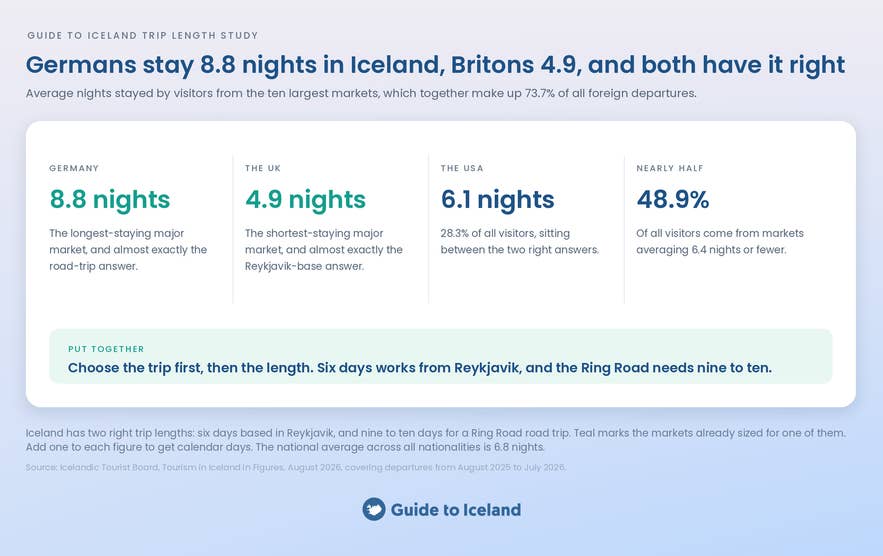
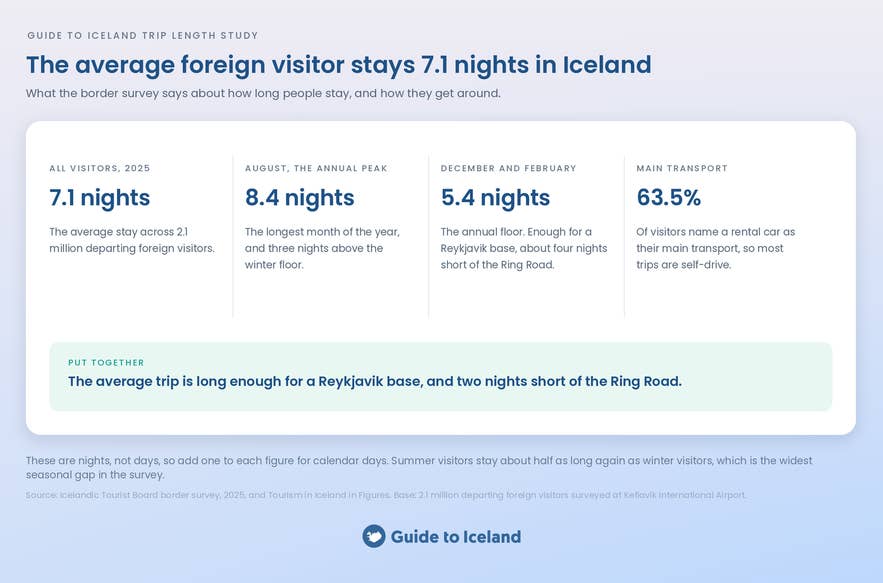
Germans stay the longest among Iceland’s ten largest visitor markets, averaging 8.8 nights, while visitors from the UK stay the shortest at 4.9 nights. That is a factor of 1.8 between the two groups flying to the same island.
Visitors from Italy average 7.4 nights, Denmark 7.1, Canada 6.7, Poland 6.4, and China 5.9 nights. The United States averages 6.1 nights, while France and Spain are among the markets with average stays of more than eight nights.
These are averages per market, not rules for individuals. Because these figures measure nights, add one day to estimate the corresponding calendar length of a trip.
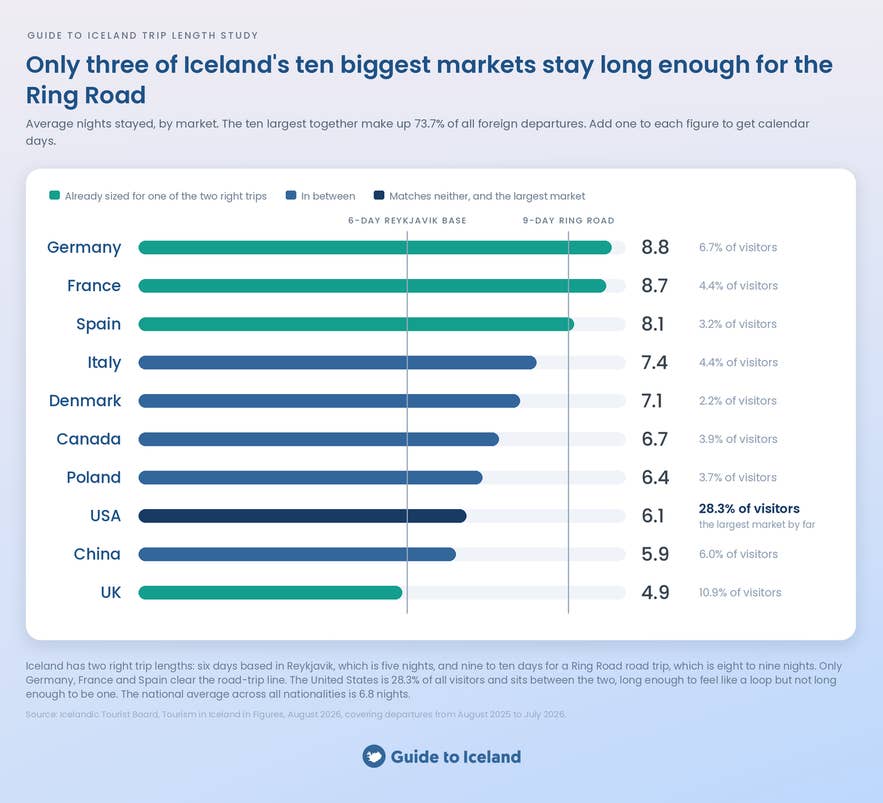
According to the graph, the ten largest markets account for 73.7% of all foreign departures from Iceland. The data comes from the Icelandic Tourist Board’s Tourism in Iceland in Figures, August 2026 edition, covering departures from August 2025 to July 2026.
Germany, France and Spain average 8.1 to 8.8 nights. That’s nine to ten days in Iceland, which matches this study’s summer self-drive recommendation. These are Iceland’s road-trip markets.
The UK averages 4.9 nights, which is a five- to six-day trip in Iceland. That matches the Reykjavik base recommendation. Britain is Iceland’s closest market with the cheapest flights. British visitors buy short city breaks in Iceland with day tours from Reykjavik, rather than a shortened version of the long road trip.
The United States averages 6.1 nights, and this is the most important figure in the data, because the US is 28.3% of all visitors. Seven days is more than a Reykjavik base needs and short of a Ring Road. This may reflect a stopover effect, with travelers adding about a week in Iceland to a longer transatlantic trip rather than planning a trip around the whole country.
Taken together, nearly half of everyone who visits Iceland (the United States, the UK, China and Poland, about one million people a year) comes from a market averaging 6.4 nights or fewer. It’s enough for an excellent trip based in the capital region.
What Do Travelers Regret About How Long They Stayed in Iceland?
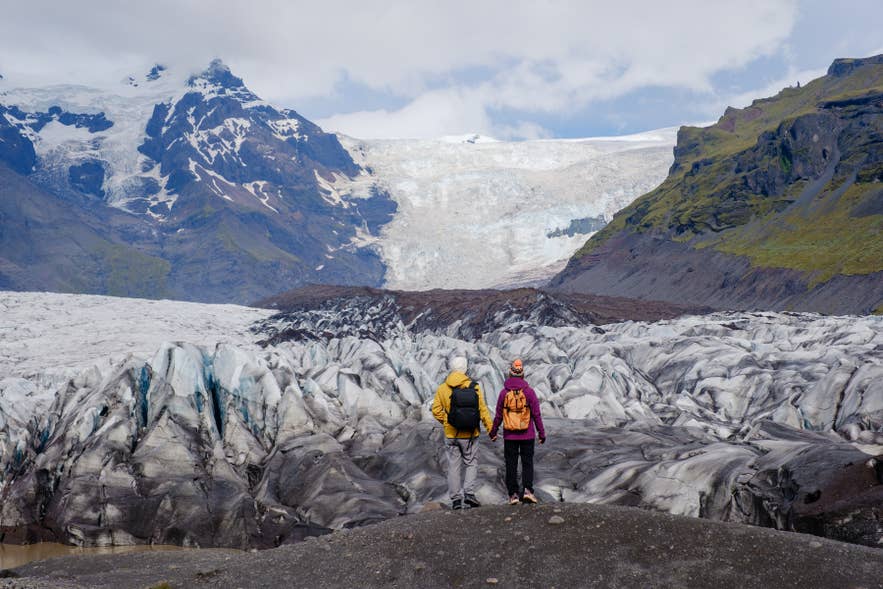
Travelers are far more likely to describe running out of time as a regret than spending too long in Iceland. We searched r/VisitingIceland, r/Iceland, the TripAdvisor Iceland forum, and the Rick Steves travel community for first-hand experiences of rushed or overly long trips.
We ran searches for “ran out of things to do,” “too long in Iceland,” and “is 10 days too long.” Reports from travelers who felt they had spent too long in Iceland return essentially nothing, while complaints about rushed itineraries appeared across trips lasting four to 14 days.
Trip length in Iceland does not determine whether travelers feel rushed. It changes what they complain about. Our forum research shows different patterns in traveler complaints as a Ring Road itinerary becomes longer.
-
Five to six days on the Ring Road: The recurring complaint is exhaustion. One traveler described pulling over to sleep in the car during the afternoon on day five just to keep going. The issue was the pace of the itinerary, not the route itself.
-
Seven to eight days on the Ring Road: Travelers start describing late arrivals. They reach their accommodation as late as 10:00 PM every night, because people plan three stops between hotels and find five or six worth making.
-
Ten days or more on the Ring Road: Complaint softens into “we had to make choices.” The few regrets about having too much time tend to involve Reykjavik, with some travelers wishing they had spent an additional night on the road instead.
Forums are also not representative of all Iceland visitors, so they over-represent ambitious itineraries. This study uses forum evidence as a tie-breaker rather than the foundation of its recommendation, with traveler ratings, booking data, and official statistics carrying more weight.
Study Method & Data Collection
 This chapter covers how the results were obtained, including the data used, its source, the analysis, and how we cross-checked and validated the rankings.
Marketplace Data
On August 30, 2026, we collected every multi-day listing across Guide to Iceland’s self-drive, vacation-package, and multi-day-tour categories, totaling 344 unique products. We extracted each product’s duration, rating, review count, and price from its structured data rather than its rendered page text.
Of those, 150 carry a rating and five or more reviews, together representing 11,175 reviews. We then repeated the same collection on Nordic Visitor, TourRadar, Intrepid Travel, and Arctic Adventures for 99 more products and 6,489 reviews.
External marketplace ratings are published on a five-point scale and have been doubled to sit on the ten-point scale Guide to Iceland uses. Doubling is a linear rescaling, so it does not affect the correlations reported here.
Viator and GetYourGuide couldn’t be read reliably and were excluded rather than approximated.
Official Statistics
Length of stay, regions visited, transport method, satisfaction, and return intent all come from the Icelandic Tourist Board’s 2025 border survey. The Tourist Board runs this survey with Statistics Iceland at Keflavik International Airport, interviewing travelers as they fly home.
We used the 2025 results and cross-checked them against the 2023 and 2024 workbooks. We also checked them against the monthly Tourism in Iceland in Figures series (August 2026 edition, covering departures from August 2025 to July 2026).
Coverage Model
Road distances come from Vegagerdin, the Icelandic Road Administration, cross-checked against an independent routing engine. Daylight is computed from NOAA solar-position data at 64.15 degrees north. This tells us how many usable hours of light you have in each month, which sets a realistic driving pace.
Daily driving rates come from first-hand traveler reports rather than assumptions. They describe a comfortable pace, not a maximum, and we treat them that way.
Winter conditions draw on three further sources: the Icelandic Road Administration’s highland road opening dates and winter road services, the Icelandic Met Office’s annual weather-warning counts, and the University of Akureyri Research Centre’s road-closure analysis of road administration data from 2010 to 2024.
Limitations of the Study
The ratings are all too similar to compare. Iceland’s multi-day products rate almost entirely between 9.0 and 9.8 on a 10-point scale, so the rating analysis has limited resolution. We’ve leaned on it to establish that length and satisfaction don’t move together.
The official survey does not split season and region together. The Icelandic Tourist Board publishes average nights by month but doesn’t cross season against regions visited. Our seasonal splits combine official monthly stay data with season-coded product analysis.
The aurora curve is a model with an assumed parameter. The graph shows your chance of a sighting rising with each extra night. The exact percentages are estimates, because no source publishes a reliable chance of seeing the northern lights on a single night.
Conclusion
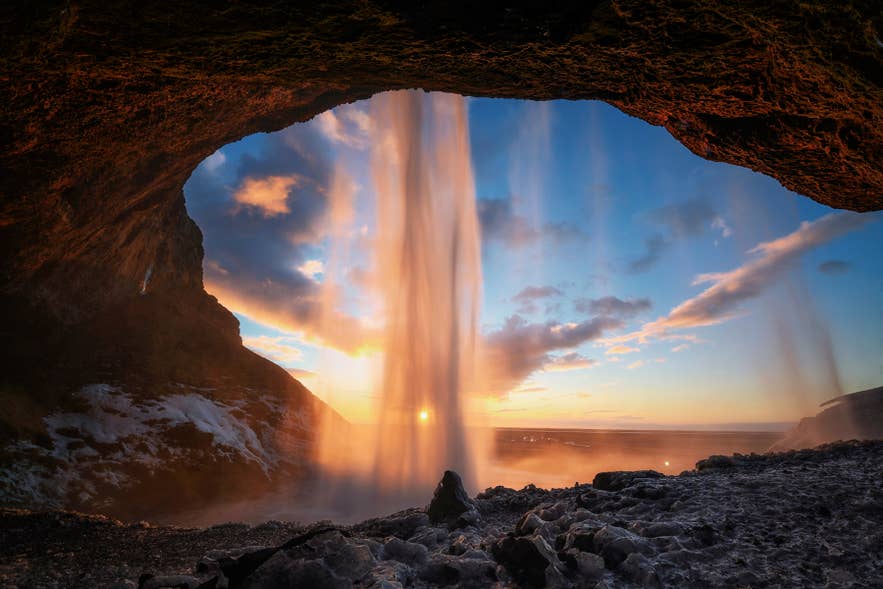
This study asked how many days you need in Iceland. The answer splits in two. A Ring Road trip takes nine to ten days in summer and ten days in winter. A trip based in Reykjavik takes six days and five nights, in either season.
The Ring Road loop itself runs seven to eight days. The extra days cover Snaefellsnes Peninsula, a day in Reykjavik, and a spare day to allow for winter weather disruptions.
Shorter loops exist, and they work. Guide to Iceland sells the Ring Road from six days in both seasons, and the shortest winter version rates 9.4 out of 10 across 193 reviews.
The mistake we found is not picking a bad trip length. It is picking a good length and then attempting the wrong trip inside it.
So decide the trip first. With six days, base yourself in Reykjavik and take day tours from the capital. Add a night at a northern lights hotel in winter, since five nights gives you a 76% to 95% chance of a sighting. With nine or ten days, book a self-drive package or a guided multi-day tour and drive the loop properly.
Start Planning Your Iceland Trip
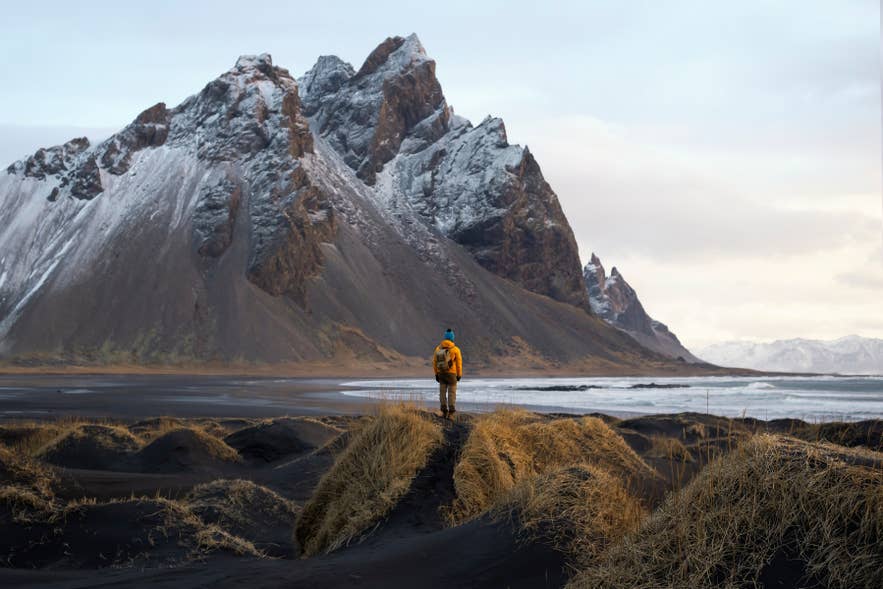
If you are comparing flight options, our study of the best airlines to fly to Iceland shows which airlines offer the best combination of price, frequency, punctuality, and comfort.
If you know your dates but not your route, start with our Iceland travel map with itinerary plans or our maps of Iceland. Both show you what fits within the number of days you have.
Then browse every Iceland itinerary we publish and pick the one that matches your trip length. The ultimate 10-day Iceland itinerary is the fullest version of this study’s summer recommendation.
This study assumes you have already decided how you want to travel. If seeing the northern lights is part of your plan, two further studies support the advice above: our 89-year study of Icelandic cloud coverage identifies the regions with the clearest skies, while our 95-year study of the Kp index shows why a dark location matters more than the month you pick.
If you plan to visit an ice cave, two studies cover when to go. The best time to visit an ice cave in Iceland covers crowds and conditions, and the safest month to visit an ice cave covers ice stability.
Our study of the best time to visit the Blue Lagoon does the same for Iceland’s busiest attraction. It shows which months and hours are quietest.
When your route is settled, choose from our vacation packages, guided multi-day tours, Ring Road tours and accommodation across Iceland. Read what to wear and pack for Iceland the week before you travel.
Guide to Iceland works with local operators across the country, so you can arrange your whole trip in one place. Every partner we list meets the highest safety standards in Icelandic tourism. Whichever length you land on, book it as one trip rather than a dozen separate pieces, and you’ll spend the days you bought in the country instead of the logistics.
How many days did you spend in Iceland? Did you drive the Ring Road or base yourself in Reykjavik, and did the length feel rushed, right, or longer than you needed? Tell us in the comments below.

Guide to Iceland Editorials is the shared byline for our content team. We use it on pieces several people worked on together, where no single writer owns the article, and on anything rewritten often enough that a personal byline would be misleading. We also publish our original data studies under this profile. Each study answers a question travelers ask about Iceland, using primary sources such as booking records, traveler reviews and public datasets, and every study is quality checked by human experts before it's published. Everything under this byline is researched and reviewed by people who live and work in Iceland. If you spot something out of date or want to suggest a correction, message us and it reaches the whole team.


