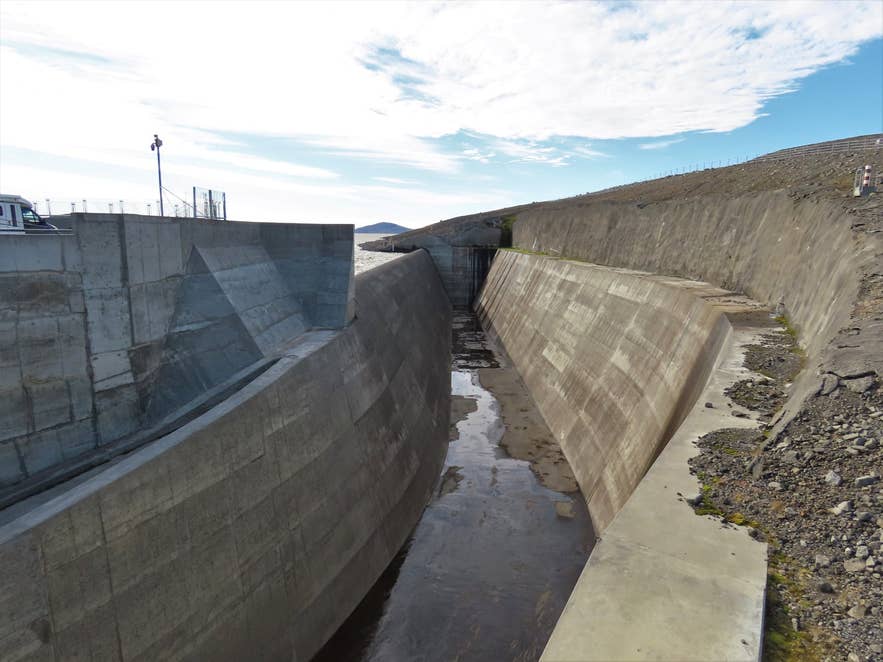
Dry Hverfandi spillway at Kárahnjúkar dam. Photo: Rémih, CC BY-SA 4.0
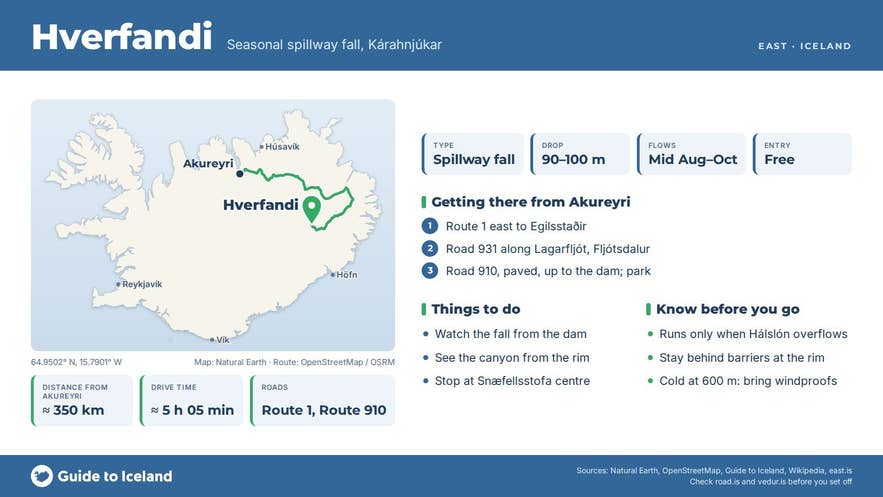
Hverfandi is a man-made seasonal waterfall at the Kárahnjúkar dam in the highlands of East Iceland, north of Vatnajökull. When the Hálslón reservoir fills in late summer, the surplus water runs over a spillway at the western end of the dam and drops 90–100 metres into the Hafrahvammagljúfur canyon.
The Icelandic name Hverfandi means "the vanishing one": the fall appears when the reservoir overflows and disappears again a few weeks later when the water level drops. It has only existed since Hálslón first filled in the late 2000s, which makes it one of the youngest waterfalls in Iceland.
Key Takeaways About Hverfandi
- Man-made seasonal waterfall at the western end of the Kárahnjúkar dam; it exists only when Hálslón reservoir overflows at 625 m.
- Drops 90-100 m into Hafrahvammagljúfur canyon; flows of roughly 200-600 m³/s have been measured when it runs.
- Usually flows from mid/late August into October; earliest recorded start 28 July, latest 9 October.
- Reached on paved Road 910 from Fljótsdalur, roughly 95 km (about 1 h 30 min) from Egilsstaðir; no 4x4 needed.
- No fee, no services at the dam; weather at 600 m is cold even in summer.
Why visit Hverfandi
Hverfandi is unlike other Icelandic waterfalls because it is engineered. Hálslón is the storage reservoir for Fljótsdalsstöð, Iceland's largest power station (690 MW, commissioned in November 2007), which was built to supply the aluminium smelter in Reyðarfjörður. The reservoir covers about 63 km² and reaches all the way to the snout of Brúarjökull, an outlet of Vatnajökull.
It is held back by three dams: Sauðárdalsstífla to the west, Desjarárstífla to the east, and the main Kárahnjúkar dam, which blocks the glacial river Jökulsá á Brú (also called Jökulsá á Dal). At about 193 m high and 730 m long, the Kárahnjúkar dam is the tallest concrete-faced rockfill dam in Europe.
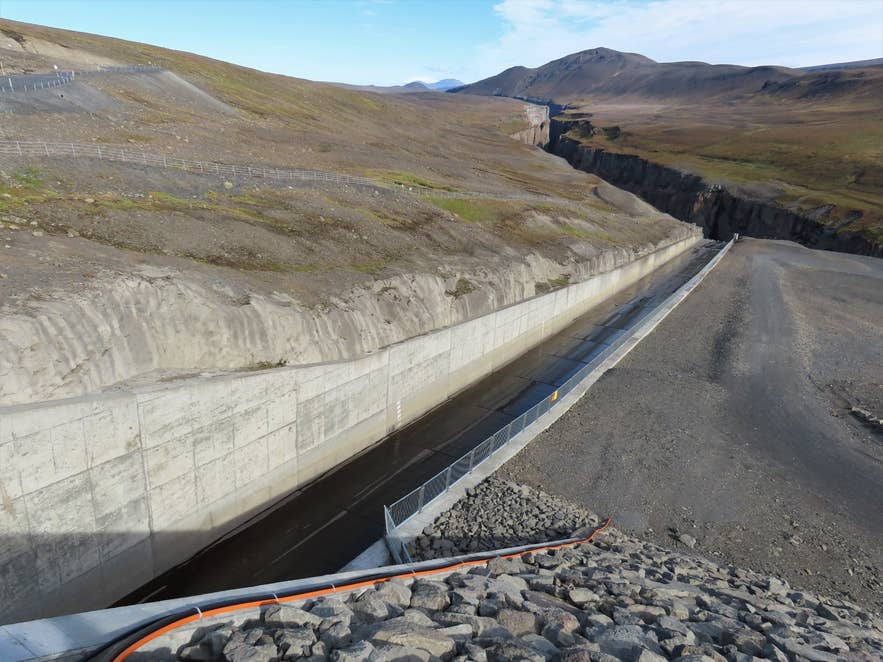
Hverfandi spillway above Hafrahvammagljúfur. Photo: Rémih, CC BY-SA 4.0
When the water surface reaches 625 m above sea level, it spills over the crest at the western end of the dam, runs down a concrete channel to the lip of the gorge and plunges into Hafrahvammagljúfur, a canyon up to 200 m deep that is also known as Dimmugljúfur, "the dark canyon".
The volume varies with the summer's melt and rain. Landsvirkjun has measured about 200 cubic metres per second in early August and a peak of around 625 cubic metres per second in the autumn of 2017, and the company says that at full flow Hverfandi can carry more water than Dettifoss, usually considered Iceland's most powerful waterfall.
The setting is treeless highland at roughly 600 m, with the Kárahnjúkar peaks above the dam, Snæfell to the south-east and the grey-green lake stretching south toward the glacier.
How to get to Hverfandi
Hverfandi is at the Kárahnjúkar dam, roughly 95 km by road south-west of Egilsstaðir. The usual route is Road 910 (Kárahnjúkavegur), which is paved from Fljótsdalur valley up onto Fljótsdalsheiði and to the dam.
From Egilsstaðir, drive south along Lagarfljót on Road 931 to Fljótsdalur, then Road 933 for a few kilometres to the start of Road 910, which climbs past the power station's intake area. Allow about 1 hour 30 minutes each way without stops.
From Reykjavík it is a full day's drive to Egilsstaðir (roughly 630-650 km on the Ring Road), so the dam is normally visited as a day trip from the east.
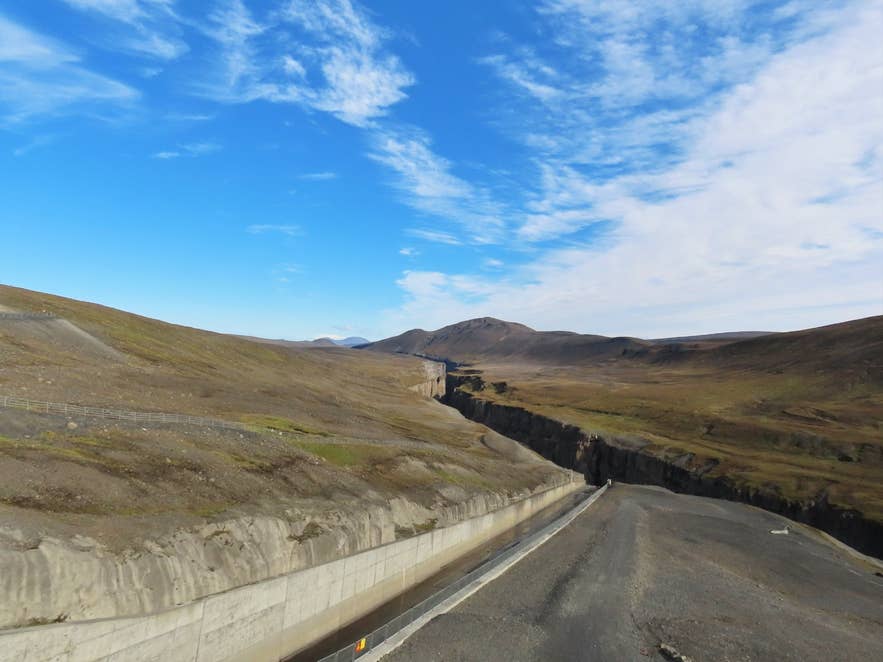
Hafrahvammagljúfur canyon below Kárahnjúkar dam. Photo: Rémih, CC BY-SA 4.0
Road 910 brings you to the dam, where you can park. The spillway and the top of Hverfandi are at the western end of the dam, and there are viewpoints at the canyon rim.
A marked trail runs along Hafrahvammagljúfur to the Magnahellir cave, but reaching its start needs a 4x4; from the dam a short walk to the viewpoints at the canyon rim is enough to see the fall. Alternative return routes run over Jökuldalsheiði or down Jökuldalur, but these are gravel highland tracks and some sections need a 4x4.
Road 910 itself is normally open from early summer until the first autumn snow; check road.is before setting out.
Best time to visit
Hverfandi only runs when Hálslón is full, which means late summer and early autumn. The overflow has started as early as 28 July (2010) and 31 July (2023), and as late as 9 October (2015); in 2022 it began on 5 September.
In the cool summer of 2024 it ran only from 20 to 26 September. The most reliable window is therefore roughly mid-August to early October; in a cool summer it may run for only a few days.
Outside this window you will see the dam, the reservoir and the canyon, but the waterfall itself will be dry. Landsvirkjun publishes reservoir levels, and local news site Austurfrétt reports each year when the lake starts to overflow.
Safety and practical tips
- Stay behind the barriers at the spillway and canyon rim. The gorge is up to 200 m deep, the edges are loose and there are no fences along most of it.
- Weather at 600 m is colder and windier than in Egilsstaðir, and fog or sleet can arrive in any month. Bring windproof layers even in August.
- There are no shops, fuel or toilets at the dam. The nearest services are in Fljótsdalur and Egilsstaðir; Snæfellsstofa, the Vatnajökull National Park visitor centre at Skriðuklaustur in Fljótsdalur, is a good stop on the way.
- There is no entrance fee, but the road is not maintained in winter.
- The water below the dam is glacial meltwater and the flow can change without warning; do not go down into the gorge.
Nearby attractions
- Hafrahvammagljúfur – the canyon Hverfandi falls into, 1 km
- Kárahnjúkavirkjun – the dam and power project, 1 km
- Hálslón Reservoir – the lake that feeds the fall, 3 km
- Laugavallalaug Hot Spring and Waterfall – a natural hot shower in Laugarvalladalur, 6 km
- Snæfell – Iceland's highest free-standing mountain, 20 km
- Studlagil Canyon – basalt-column canyon revealed when the dam lowered Jökulsá á Dal, 33 km
Tours that visit Hverfandi
- Studlagil Canyon and Highland Circle Day Tour from Egilsstadir or Seydisfjordur – an 8-hour 4x4 bus tour that stops at the Kárahnjúkar dam, Hafrahvammagljúfur and Laugarvalladalur as well as Stuðlagil and Rjúkandi; from late August to early October the itinerary includes Hverfandi when it is flowing.