


The difference between Vegvisir vs Aegishjalmur is that one guides, while the other guards. Discover what these two Icelandic magical staves mean, where they come from, and why neither is truly a Viking symbol, plus where to see them on your trip to Iceland.
Vegvisir and Aegishjalmur are two of the most recognized Icelandic magical staves, known in Icelandic as galdrastafir. The Vegvisir, the "wayfinder," is a symbol of guidance meant to keep its bearer from losing their way. The Aegishjalmur, the "Helm of Awe," is a symbol of protection and power meant to instill fear and strengthen the wearer. One guides, the other guards, but neither belongs to the Viking Age.
Why You Can Trust Our Content
Guide to Iceland is the most trusted travel platform in Iceland, helping millions of visitors each year. All our content is written and reviewed by local experts who are deeply familiar with Iceland. You can count on us for accurate, up-to-date, and trustworthy travel advice.
We reached out to Terry Gunnell, a folkloristics professor at the University of Iceland and a leading expert on Icelandic folk tradition, to set the record straight.
There are very few ancient runic inscriptions found in Iceland. The Fuþark runic alphabet is nonetheless the same. The galdrastafir (magic runes) are different. These were collected in the nineteenth century, and published first in Jón Árnason's collection of folk tales.
You will see both in tattoos, jewelry, artwork, and pop culture. In Iceland, you can view the original staves at the Museum of Icelandic Sorcery and Witchcraft, a popular stop on Westfjords tours, or find both symbols as souvenirs.
That distinction matters. Their actual recorded appearances come from post-medieval Icelandic manuscripts: the Vegvisir from the Huld Manuscript of 1860, and the Aegishjalmur from grimoires dating to the 17th century, though the first mention of the name Aegishjalmur comes from the Eddic poem "The Lay of Fálnir" (Fáfnismál), stanza 16-17, where it seemingly means a literal helmet of terror.
Their connection to Icelandic magical staves has helped preserve them as lasting pieces of the country's mystical tradition.
Vegvisir and Aegishjalmur carry meanings of protection, guidance, and strength, but their purposes are very different. This guide explains the meaning, origin, and key differences between the two staves. If you are drawn to their symbolism or thinking about getting one as a tattoo, here is what you need to know.
Key Insights on Vegvisir vs Aegishjalmur
-
Galdrastafir, or Icelandic magical staves, are symbolic diagrams used in folk magic for protection, guidance, luck, or fear.
-
The Vegvisir is often called the “Icelandic compass.” It symbolizes spiritual direction and protection for those who feel lost or uncertain.
-
The Aegishjalmur, or “Helm of Awe,” is a symbol of power and psychological defense. It was believed to instill fear and fortify the wearer’s strength.
-
The stave images as we know them today first appear in Icelandic books on magic written centuries after the Viking Age, such as the Galdrabok and Huld Manuscript.
-
While similar in form, the Vegvisir and Aegishjalmur serve very different purposes: one guides, the other guards.
-
Today, both are widely used in tattoos, jewelry, and spiritual practices.
Icelandic Magical Staves Explained
 Icelandic magical staves, known as galdrastafir, are a unique part of Iceland's esoteric heritage. These intricate symbols were a visual form of folk magic believed to hold protective, guiding, or fearsome powers. Each stave had a specific purpose. Some were meant to ward off evil, instill fear in enemies, locate lost objects, or bring luck.
Unlike runes, which formed part of a written alphabet used across Germanic cultures, galdrastafir were not tied to sound or language. They had no spoken equivalent. Instead, they functioned purely as visual spells.
How Icelandic Staves Were Used
 Magical staves were often paired with chants, rituals, or written instructions. Some were drawn with blood or ink. Others were carved into animal hides, etched into bones, or inscribed onto wood or paper.
These staves were usually passed down through handwritten grimoires. These books of spells combined Christian elements, Norse mythology, and local superstitions.
Where the Staves Come From
 Most known staves come from early modern Icelandic manuscripts. The best known is the Galdrabok, also called Galdrakver. This 17th-century grimoire contains dozens of magical signs and their uses. While often assumed to be Viking in origin, nearly all surviving examples were recorded centuries after the Viking Age had ended.
Among the most recognizable staves are the Aegishjalmur (Helm of Awe), said to inspire fear and provide protection, and the Vegvisir (Wayfinder), said to keep one from losing their way.
Other examples include Gapaldur and Ginfaxi, used to gain the upper hand in wrestling; Lukkustafir, for attracting good luck; Thjofastafur, intended to expose thieves; and Draumstafir, used to influence dreams.
Though post-medieval in origin, these staves reflect a long-standing Icelandic belief in hidden forces and magical intervention. The harsh landscape, cultural isolation, and blend of Christian and Norse spiritual traditions all shaped this symbolic system. Today, galdrastafir remain a compelling part of Iceland's mystical and cultural identity.
The Vegvisir, Iceland's Wayfinding Stave

Vegvisir, often called the "Viking compass," is a magical stave found in Icelandic folk tradition. Its name combines vegur ("way" or "road") and visir ("guide" or "pointer"), translating roughly to "that which shows the way."
First recorded in the Huld Manuscript in 1860, the Vegvisir was said to help its bearer avoid getting lost, even when the way was unknown. Its design features eight unique arms radiating from a central point, resembling a symbolic compass rather than a practical one.
Though frequently associated with Viking lore, there is no evidence it was used during the Viking Age. Instead, it belongs to a later tradition of Icelandic folk magic.
Symbolic and Modern Interpretations
 In the Huld text, the Vegvisir appears alongside a note claiming that if the sign is carried, the bearer will never lose their way in storms or bad weather, even when the way is not known. Some modern interpretations take this literally, while others view it as a symbol of emotional or spiritual direction.
Despite its late appearance in written sources, many see the Vegvisir as reflecting older oral traditions that valued visual symbols as charms or wards.
Its radial structure, while resembling a compass rose, does not align with cardinal directions. The eight arms may represent metaphoric paths or life challenges, with the central point symbolizing the self.
The Aegishjalmur, the Helm of Awe

The Aegishjalmur, or "Helm of Awe," is an Icelandic magical stave known for its association with fear and strength. The name combines aegis ("awe" or "terror") and hjalmur ("helm" or "helmet").
The name Aegishjalmur first appears in the Norse poem "Fafnismal" from the Poetic Edda, where it's described as a literal helmet that instills terror, but the symbol's visual form doesn't appear until much later.
A well-known version comes from Galdrakver (also called Galdrabok), an Icelandic grimoire from around 1670 that describes the stave as one to be marked between the eyebrows to overcome enemies.
A similar stave with a different design appears in En islandsk svartkonstbok, a Swedish manuscript from around the same period. There, the Aegishjalmur is described as calming anger, though it is still applied to the forehead. An even earlier form exists in a Danish manuscript dated between 1490 and 1510, visually closer to the Swedish version than the Icelandic one.
The Icelandic version typically features eight tridents radiating from a central point, forming a symmetrical and intimidating shape. This repetition may have been designed to overwhelm or confuse the viewer.
Mental Defense and Symbolic Strength
 In magical practice, the Aegishjalmur was more than a protective charm. It served as a psychological shield. The Galdrabok outlines its use in rituals that involve applying the symbol to the forehead and reciting spells, linking it to the idea of the "third eye" and inner control.
Modern interpretations often frame the stave as a tool of mental fortification, meant to sharpen resolve, project dominance, and ward off negative energy.
The works containing Aegishjalmur and Vegvisir are both preserved at the National and University Library of Iceland. Both have been digitized and are available to browse through the library's online archive.
Vegvisir vs. Aegishjalmur: Key Differences
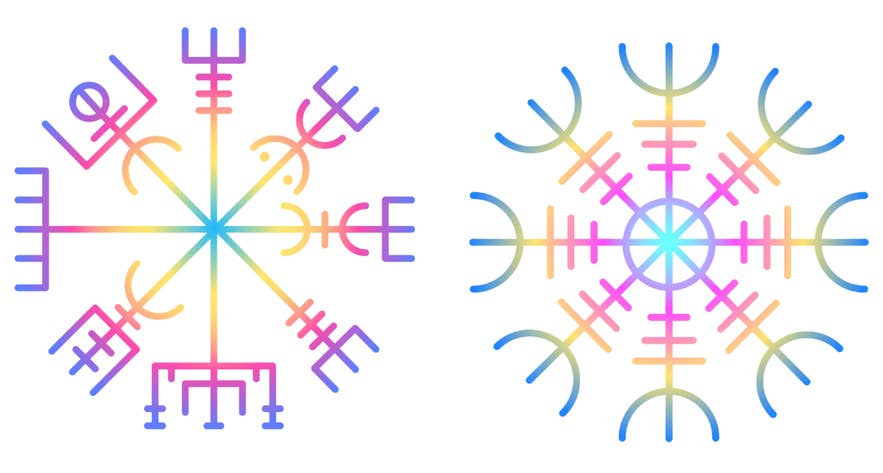 While the Vegvisir and Aegishjalmur both belong to Iceland's magical stave tradition, they serve very different symbolic purposes. Their energy, intent, and visual construction reflect two contrasting approaches to uncertainty, power, and protection.
Intent and Emotional Tone
 At its core, the Vegvisir offers direction and reassurance. Its meaning is rooted in navigating difficulty without losing one's way, making it a symbol of inner focus and spiritual clarity. The energy it conveys is calm, grounded, and quietly protective.
In folk magic, this tied the Vegvisir closely to travel, decision-making, and surviving literal or metaphorical storms. It was drawn to keep the bearer safe and centered through challenges.
The Aegishjalmur, on the other hand, is meant to assert dominance and repel threats. It evokes awe or even fear, offering psychological armor rather than gentle guidance. Its presence is commanding and confrontational.
In Icelandic folklore and manuscripts, it was used to unnerve enemies and safeguard one's strength in hostile situations, especially in battles of will or fear.
Visual and Structural Contrast
 Both symbols use radial symmetry and eight arms, but the visual tone they strike is dramatically different. The Vegvisir’s varied, delicate shapes resemble direction markers or runic signs. It looks like a spiritual compass.
The Aegishjalmur’s repeated, spiked tridents form a tight, weapon-like grid. Its aggressive symmetry communicates focus, resistance, and impenetrability.
Cultural Positioning and Mythic Associations
 The Aegishjalmur has a closer conceptual tie to Old Norse mythology, particularly through its mention in the Poetic Edda. Even though its visual form is later, it carries a legendary aura.
The Vegvisir has no mythological roots. It first appears in 19th-century manuscripts and reflects Icelandic folk belief rather than Viking myth. Its appeal is more personal than heroic.
You can view both symbols up close at the Museum of Icelandic Sorcery and Witchcraft in Holmavik, one of the most immersive places to explore Iceland's folk magic tradition. If you are planning a trip to the region, Westfjords tours offer more experiences in the area.
Popularity and Tattoo Culture of Vegvisir and Aegishjalmur

The Vegvisir and Aegishjalmur have taken on new life far beyond their original magical contexts. Their striking designs and symbolic depth have made them favorites in contemporary culture, especially among those drawn to Norse heritage, spirituality, and visual storytelling.
In recent years, both have surged in global popularity. They are especially common in tattoo culture and Norse-inspired fashion. Their roots lie in Icelandic folk magic, but modern interpretations often reflect personal meanings that go far beyond their original use in grimoires.
Cultural Influence and Misconceptions

Photo by Paul Familetti, via Wikimedia Commons, licensed under CC BY 2.0. No edits made.
Celebrities have helped spread these symbols. Icelandic artist Bjork has a Vegvisir tattoo on her arm. Her embrace of Icelandic cultural heritage through music and visual art has brought symbols like the Vegvisir and Aegishjalmur into the international spotlight.
This growing popularity comes with a risk of misinterpretation. Many people assume these are Viking symbols or part of the Norse religion, which is historically inaccurate.
Both staves draw on Norse concepts of protection and mysticism, but their actual recorded appearances date from centuries after the Viking Age. They belong to Iceland's post-medieval magical tradition, not Viking warfare or navigation
The Enduring Power of Vegvisir and Aegishjalmur
 The lasting appeal of the Vegvisir and Aegishjalmur lies in their adaptability. These staves continue to inspire people to find strength, stay grounded, or move forward, just as Icelandic folk magicians once intended.
Their modern use reflects a timeless human desire for protection, clarity, and resilience. The Vegvisir speaks to those seeking direction, while the Aegishjalmur resonates with those wanting strength.
To see the original staves and the grimoires they came from, visit the Museum of Icelandic Sorcery and Witchcraft in the Westfjords, or explore the wider tradition in our guide to Icelandic magical staves.
Vegvisir 和 Aegishjalmur 是维京符号吗?
Vegvisir 和 Aegishjalmur 哪个更好?
Vegvisir 这个词是什么意思?
Vegvisir 起源于哪里?
北欧文学中提到过 Aegishjalmur 吗?
传统上 Aegishjalmur 是怎么使用的?
Aegishjalmur 有相关的仪式吗?
Vegvisir 与基督教相冲突吗?
有哪些符号与 Vegvisir 相似?
- Veldismagn:随身携带,用于旅行中的安全与保护
- Lukkustafir:绘制来吸引好运
- Aegishjalmur:外形相似,但更偏向守护而非指引
如果我不是冰岛人,可以佩戴 Vegvisir 或 Aegishjalmur 吗?
Which one speaks to you more, the Wayfinder or the Helm of Awe? Tell us in the comments below, and share your own Vegvisir or Aegishjalmur story.

I'm an Icelandic folklorist writing about Icelandic nature and culture for travelers. I share practical guides, cultural insights, and tips on hidden spots, helping you experience the best of Iceland and maybe come to love it as much as I do!


